
In the market of new materials, the functional materials having unusual properties are in great demand, among which the ferromagnetic shape memory alloys are predominant. The control over such properties is exercised using force, thermal and magnetic fields. An important aspect of improvement in the material properties is to create a nanostructured state, which has significant advantages in magnetic and mechanical characteristics in contrast to the bulk materials in crystalline or amorphous state.
Cu-Al-Mn alloys are ones of the most interesting alloys with shape memory effect. To get their optimal properties. these alloys usually undergo an additional thermal, mechanical or magnetic treatment. Thus, aging of Cu-Al-Mn alloys leads to the formation of a system of nanoscale particles of ferromagnetic Cu2MnAl phase in a paramagnetic Cu3Al matrix, and annealing in a magnetic field increases the Tc of Cu-Al-Mn alloys. At the same time, the heat treatment allows to control a number and a size of particles in the alloy, and also the martensitic transformation temperature and hysteresis, which depend on characteristics of precipitated particles [1].
The work is devoted to the influence of a magnetic field on magnetic and mechanical properties of a Cu–Mn–Al alloy under annealing. The comparative analysis of the magnetic-field orientational impact on solid-solution decomposition processes in a fixed annealing procedure is held using the methods of low-field magnetic susceptibility (fig. 1), specific magnetization, and microhardness test. The work highlights changes in the magnetic and mechanical properties of a Cu–Al–Mn alloy associated with the change in a critical size of forming precipitated ferromagnetic phase, and determines correlation in the behaviour of magnetic and mechanical properties of the alloy, depending on a critical nucleus size of forming precipitated ferromagnetic phase.
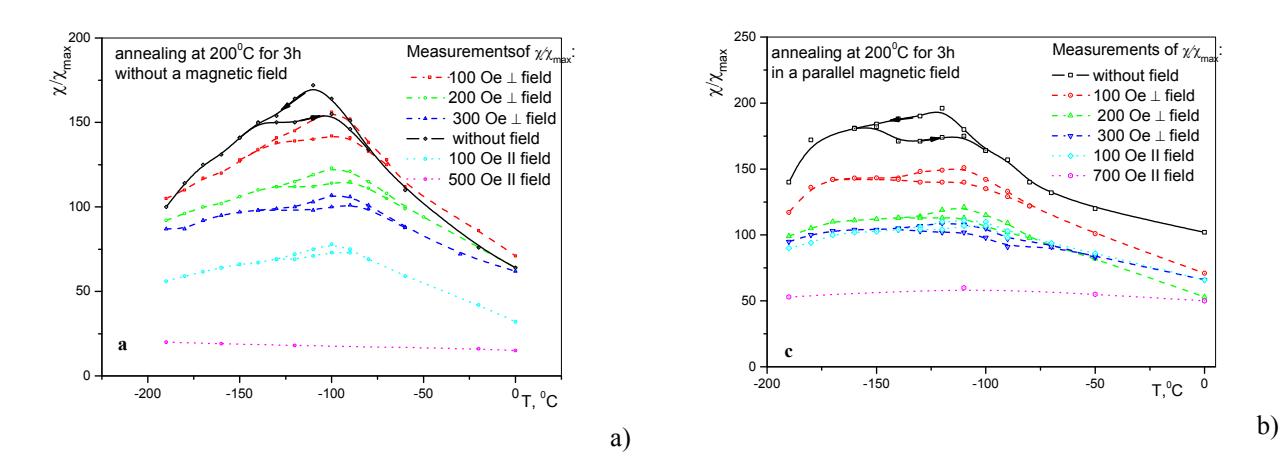
The work was attempted to process control of phase formation at aging of high temperature phase using the constant magnetic field in order to optimize the parameters of martensite transformation behavior in Cu-Al-Mn alloy. With the help of the phenomenological theory of diffusion decay and obtained experimental results, the character and causes of the induced MT behavior in the alloy were determined. One can assume that applying a magnetic field stimulates the formation of ferromagnetic nanoparticles during the decay of solid solution. In addition, thermomagnetic treatment helps to create effective nucleation centers of nanoparticles in Cu-Al-Mn alloy during the aging of high temperature phase. The treatment in the magnetic field causes the reduction in a particle size that appears in the decrease of magnetic characteristics of the alloy, however, increases the alloy microhardness.