Selective accumulation of endogenous sensitizer precursors, such as 5 – aminolevulinic acid (5 – ALA) and its derivatives in photodynamic therapy (PDT), entering cancer cells and disrupting the cell cycle of heme biosynthesis leads to photosensitized effect to tumor tissue. Cancer cells accumulate higher amount, concentration of photosensitizer protoporphyrin IX (PpIX) than healthy ones. However, several porphyrin precursor products, (e.g., Levulan, Metvix, that are approved and used in clinical practice for treating actinic keratosis and other superficial tissue precancerous and cancerous diseases) possess limited penetration in biological tissues. This quality based on chemical structure interferes with the control of selectivity of sensitization for deeper or larger volume of cancer affected tissue and limits the clinical application of the PDT method. In order to extend the application of the precursors to treat cancers of larger volume and to increase the efficacy of the selectivity of PDT, for transportation of the sensitizer precursor to the target cells different molecular weight polymeric compounds of hyaluronic acid (HA) are used, which are now being applied in cosmetics and rehabilitation medicine. HA agent facilitates drug delivery across the cell membranes [1]. It is also well-known, that HA is highly bound to the receptors CD44, CD168 found in cell membrane [2].
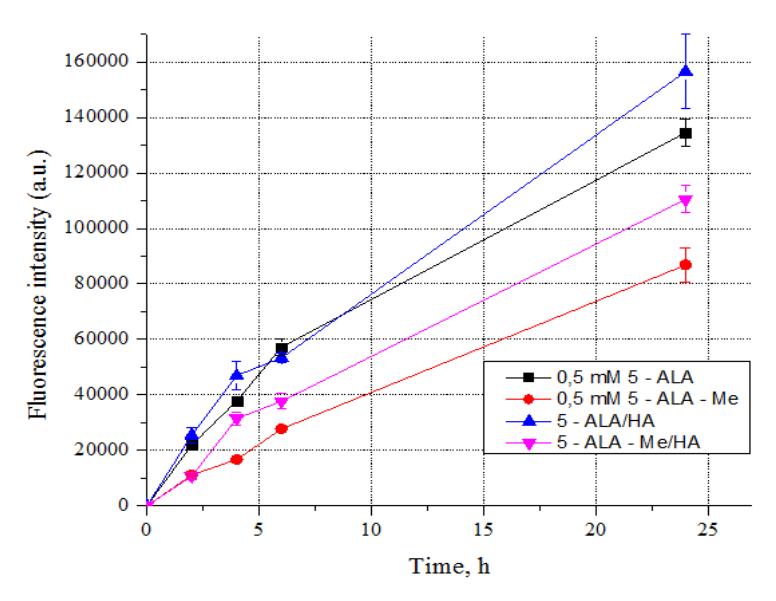
The study analyses HA product in cooperation with a 5 – ALA or its methyl ester (5 – ALA – Me), the influence of induction of endogenous PpIX in human breast adenocarcinoma (MDA-MB-231) cell populations. The MDA-MB-231 cells were incubated for 2, 4, 6, 24 hours with 0.5 mM 5 – ALA or 5 – ALA – Me, in the culture medium plus 0.1 mg/ml HA. The changes in the intensity of PpIX fluorescence in time were registered with the help of flow cytometry and florescence spectrometer.
The experiments revealed, that adding the HA into the media with 5 – ALA or 5 – ALA – Me, increases the intensity of the PpIX fluorescence. For PDT is very important to achieve more selective PpIX induction in cancer cells as fast as possible, in order to start an early radiation therapy. Thus, our results shows that after 4 hours of incubation with 5 – ALA – Me/ HA mixture the PpIX fluorescence intensity increases by 88.6% compared to 5 – ALA – Me, and in the case of 5 – ALA/HA mixture the intensity of PpIX fluorescence inreases by 24% (Fig.1).