1,8-naphthalimide derivatives destinguish effective fluorescence and they are used in a wide range of applications such as organic light-emitting diodes (OLED) [1], fluorescent markers in biology and medicine [2], pH sensors [3], fluorescent dyes [4], etc. 1,8-naphthalimides contain a nitrogen heteroatom in their structure, which leads to a phosphorescence emission even at room temperature. The aim of this reasearch was to investigate triplet states and their infuence to photophysical properties of the derivatives with 1,8-naphthalimide backbone and different polarity moiety.
Spectral analysis revealed that increasing polarity of moiety determines a shift to longer wavelengths in absorption and fluorescence spectra. Adding a robust donor as a substituent leads to an increase of Stokes shift. These alterations are affected by the increase of dipole moment and intramolecular charge transfer (ICT) through donor-acceptor interaction.
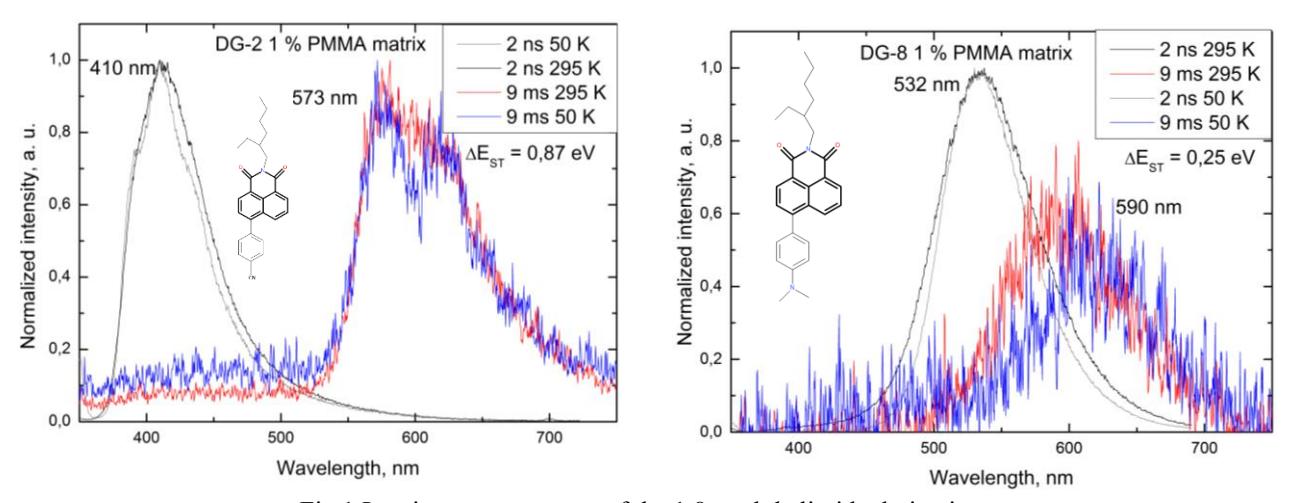
Spectra of luminescence (Fig.1) were investigated at different delay times after optical excitation. After 2 ns signal of fluorescence and after 9 ms signal of phosohorescence were observed. Further spectral analysis revealed that triplet state energy however does not depend on the polarity of substituent and allocates at 570 nm. Phosphorescence of the derivatives is determined by the stucture of 1,8-naphthalimide. Since triplet state energy is equable and energy of singlet state is influenced by the polarity of moiety, the energy gap between singlet and triplet states ($\Delta E_{ST}$) can be modified. Substituents with electron donating properties allow to achieve a small singlet-triplet energy gap. Diminished energy gap increases a chance of reverse intersystem crossing (RISC) and processes of thermally activated delayed fluorescence (TADF).