
Low electrical conductivity of many materials proposed for cathodes in lithium and sodium batteries is the main reason for the modest performance of electrochemical cells. There are many propositions to address this issue. In recent years, J.E. Garbarczyk and co-workers have proposed and investigated an alternative route to the conductivity enhancement, namely a thermal nanocrystallization of glassy analogs of the important crystalline cathode materials [1, 2], such as: V2O5, LiFePO4 and Na3V2(PO4)2F3. The advantages of our approach to produce active cathode materials include the absence of carbon additives and simplicity and straightforwardness of synthesis, which consists of two stages only: glass preparation by melt-quenching and thermal treatment of the glass to induce its nanocrystallization. Our experience with that method has shown that one can, by the appropriately chosen heat-treatment conditions, achieve a huge (even by a factor 109) and irreversible conductivity enhancement.
In this work, thermal and structural analysis on Li3xNa3(1-x)V2(PO4)3 ($0 \le x \le 1$) materials were carried out. These are promising compounds that can be used as cathode materials in batteries. They have a high specific capacity, but also low electronic conductivity. Samples labeled as N08N and N10N were synthesized with 30% and 50% excess of sodium, respectively. Differential thermal analysis (DTA) study determined the characteristic temperatures of glass transition and crystallization. This temperatures ranged from 401°C to 479°C for glass transition and from 461°C do 615°C for crystallization. This knowledge allows for thermal nanocrystallization of investigated materials. X-ray diffraction (XRD) for samples at room temperature confirmed amorphousness of almost all obtained sodium materials. Samples with lithium had enough time for crystallization. Temperature dependent XRD studies for lithium samples determined presence of two phases: Li3V2(PO4)3 and LiVOPO4, which occured at 440°C.
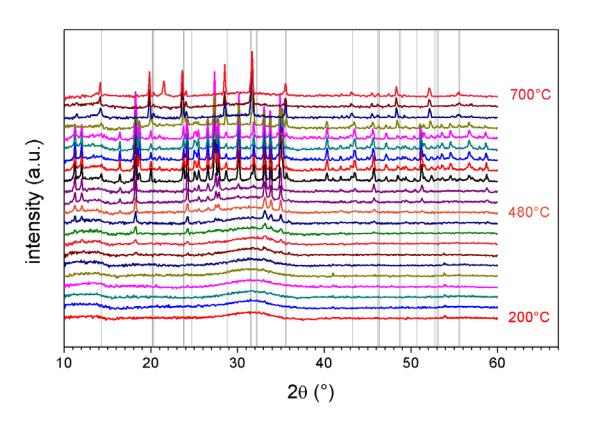
For sodium samples, XRD study determined Na3V2(PO4)3 and NaVOPO4 phases (Fig. 1a). However, the latter (unwanted) phase disappeared at higher temperatures (Fig. 1b). Sizes of crystallites, calculated with Scherrer's formula are within range 26–150 nm.