
Transparent laser ceramics are acknowledged as the potential replacements for single-crystals counterparts with several remarkable advantages such as easy fabrication, high concentration [1]. Therefore, the ceramics have a higher resistance to thermal shock than single crystal, making them more suitable for high intensity laser pumping [2].
The goal of this work were to approach the difference between Yb:YAG monocrystalline and ceramic CW lasers, to conduct a literature review on the basics of laser technologies. This experiment was conduct using a 10% monocrystalline Yb:YAG with 100.4mm optical resonator (fig 1).
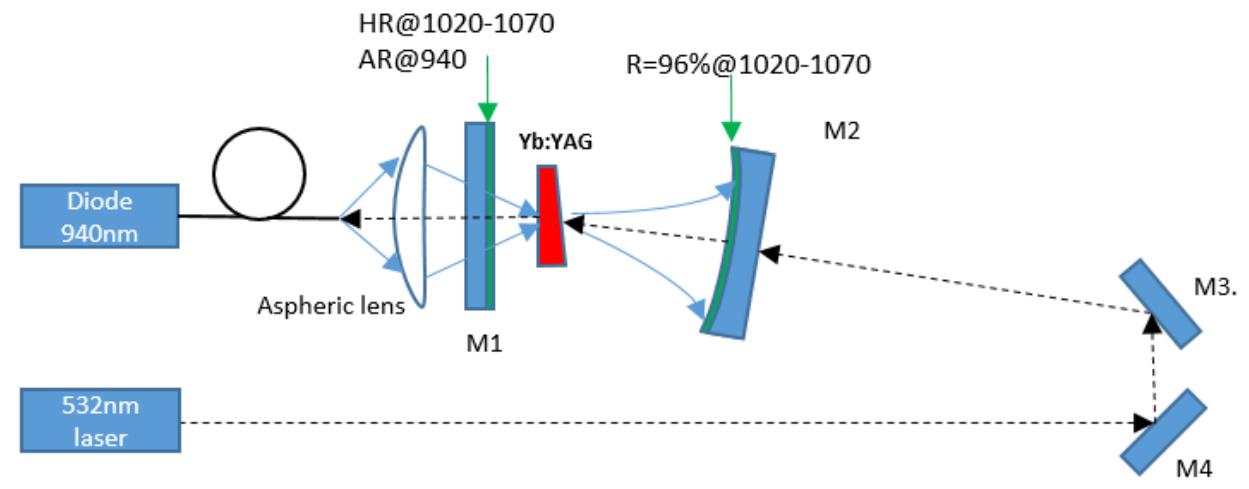
During this attempt a 1.61W generation threshold and a 1W output power were reached with laser efficiency of 22.5%. In order to compare a monocrystalline with polycrystalline, a 10% Yb:YAG ceramic was used. During this attempt a 2.36W generation threshold and 130mW output power were achieved with laser efficiency of 2.3%. Furthermore, output beam were linear polarized and 15 fold difference between polarization waves was got.