Supercontinuum generation in bulk solids gathers a lot of interest from both research and practical applicability standpoints. The resulting spatio-temporally coherent radiation has multi-octave spanning spectra and high shot-to-shot stability when pumped by CEP-stabilized pulses. In the anomalous dispersion case the pulses may self-compress to few-optical cycles and have soliton-like spatial structures.
For femtosecond pulses pump energies above a few µJ cause the continuum to lose its spatio-temporal coherence due to multiple pulse splitting and modulational instability. Combined with the low efficiency of the process, the new spectral components account for energies on the order of nJ. A recently demonstrated novel method of continuum generation proposes using multiple thin plates instead of one continuous piece of material [1]. This means that the spectrum is broadened in each successive plate, but because the nonlinear foci are outside the material, the pulse energies can be of several orders higher (hundreds of µJ).
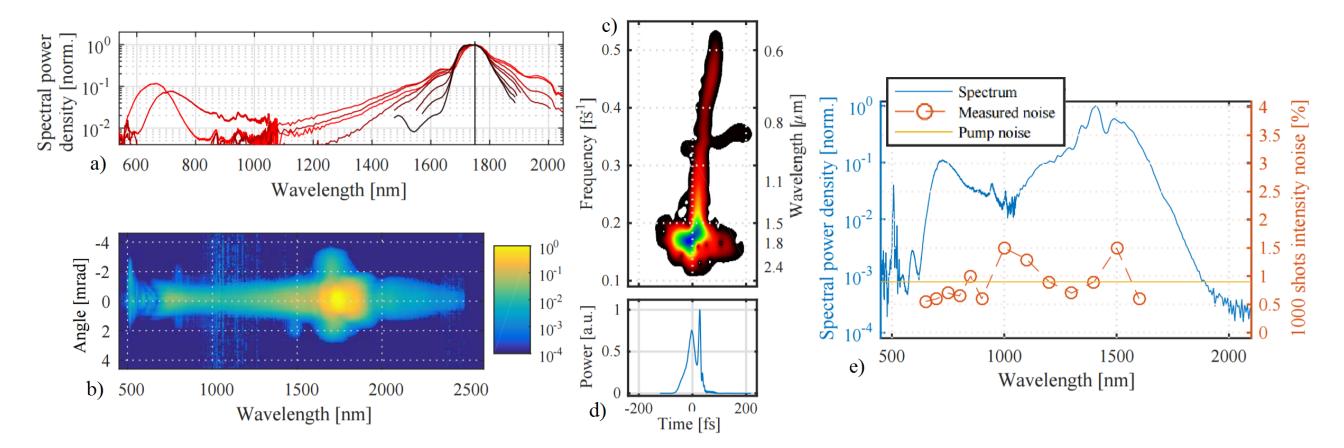
We performed characterization of multi-plate continua pumped by a previously-unexplored wavelength range of 1.1-1.75 µm. We used a mix of 0.1-0.2 mm thick sapphire and fused silica plates. The distances between the plates were chosen as to facilitate the maximum spectral broadening without destroying the spatio-temporal coherence of the pulses or causing optical damage to the plates. The shape of continuum spectra using different pump wavelengths was quite consistent and reminiscent of continua generated in bulk solids. The measured frequency-resolved angular spectra show that for all pump wavelengths almost all the energy and bandwidth is concentrated in the near-axial angular components, which allows for efficient spatial filtering in the Fourier plane. The spectral energy density of the visible part of the spectrum is typically above 10 nJ/nm, 2-3 orders of magnitude higher than in bulk media. Using the SFG-XFROG method, we observed smooth spectral phases except for modulations in spectral phase and intensity around the pump wavelength, which is also the case for continua generated in bulk solids. The temporal structure of the pulses shows several subpulses: the leading subpulse contains frequencies lower than the pump and has the larger part of the energy, while the trailing sub-pulse has the higher frequencies and the larger part of the bandwidth (therefore can reach few-cycle durations).
The range of pump energies that can be used is constrained on the low end by the decreasingly small plate spacing, which is required to achieve sufficient intensities in the plates for spectral broadening. On the high end, femtosecond pulses exceed the critical self-focusing power in air, which causes filamentation and the interplay between air and plate nonlinearities to degrade the stability of the continuum. We observed a difference of 30% in pump energies between the onset of normal continuum generation and optical damage. The shot-to-shot energy stability was below 1% for most wavelengths, with exceptions around 1 and 1.5 µm, which can be explained by the narrow bandwidth of interference filters (10nm) and spectral peaks near those wavelengths. The measured CEP noise level in the multi-plate case was very similar to continuum generation in bulk solids.