
The effects that are induced by exposing biological tissues and cell suspensions to electric fields are intensively investigated. Pulsed electric fields are an effective method for improving conventional procedures such used in chemotherapy, gene transfer, microbiological inactivation in food preservation and the extraction of intracellular compounds. It has been previously shown that in mammalian cells, a nanosecond pulsed electric field (nsPEF) can improve the permeability of the plasma membrane, alter gene expression, cause phosphatidylserine translocation, affect the distribution of intracellular ions and even lead to the death of the cell [1].
Budding yeast (Saccharomyces cerevisiae) is one of the most well-studied and understood eukaryotic organisms. It is an irreplaceable component in the food industry, where it is used in the preparation of fermented foods and beverages and in the pharmaceutical and biotechnology sectors, where it is used for the production of recombinant proteins. In addition, it is also a highly useful organism for theoretical and practical modelling [2]. Yet there is still a lack of sufficient data related to the effects of nsPEF on yeast cells.
In our study Saccharomyces cerevisiae yeast cells were used as a model organism to investigate the effects of various pulsed electric fields on the programmed death of such cells. We analysed the effects of square shaped electrical pulses of different duration ($\tau = 10$-90 ns) and pulse number (pn = 1-5) with electric field strength (E) up to 220 kV/cm and showed that nanosecond pulses can induce the cell death, which in turn is dependent on the electric field pulse parameters and increase with the rise in E, $\tau$ and pulse number (Fig. 1).
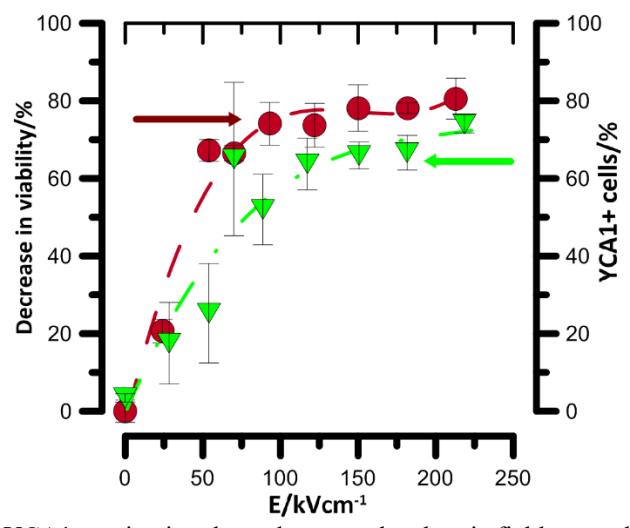
Since nsPEFs which treated the electroporation buffer did not cause any reduction in the viability, we concluded that nsPEFs affects yeast cells directly. Exposure of yeast cells to nsPEFs was accompanied by metacaspase activation, membrane permeability to propidium iodide and the externalisation of phosphatidylserine. We conclude that square shaped electric field pulses with nanosecond durations induce caspase-dependent apoptosis in yeast cells, which in turn can be used as a model for more detailed analysis of the programmed cell death analysis induced by nsPEFs [3].