
Among conjugated polymers polypyrrole (PPy) is well known for its semiconductor properties [1], quick and simple polymerization and wide use in chemical sensors, electrochemical devices and batteries [2]. Due to its ability to convert electrogamnetic energy into thermal energy PPy could be used for engineering electromagnetic wave absorbers [3]. Polypyrrole can be synthesized by electrochemical, chemical and biocatalytic polymerization methods with variety of oxidizing agents. Here we observe two methods for PPy microsphere formation. A "green" method when microspheres are obtained in biocatalytic medium (BPPy) and microemulsion polymerization (MPPy)[4].
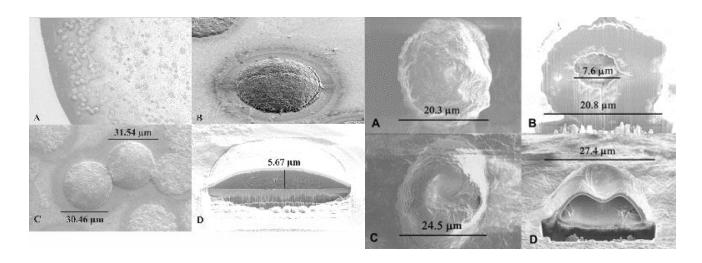
Bacteria Streptomyces spp. and pure pyrrole were used to carry out "green" biocatalytic microsphere synthesis. Optimal material proportions were assessed varying different pyrrole concentrations in bacteria medium. 30 mM pyrrole concentration was selected because it had no effect on bacteria vitality. After 10 days of inoculation in the bacterial medium with pyrrole monomer, changes in flasks were noticed. Samples were prepared for morphological and structural analysis by centrifugation and drying overnight in air at 25 °C. Optical microscope and FIB-SEM images confirmed oval and hollow BPpy microsphere structure. X-ray photoelectron spectroscopic analysis was measured using "Escalab MK II" with radiation source MgKα, registrating C 1s, N 1s and O 1s compound spectrum areas. XPS spectra analysis processed using the Avantage software [5].
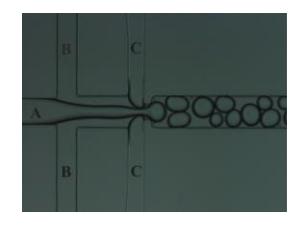
Microemulsion polymerization was carried out using a special 5 tubular microfluidic system. Microemulsion formation was observed with optical microscope and "Guppy" camera set. As a separating phase for the iron (III) chloride and pyrrole monomer, a solution of propylene carbonate (PC) was used. In this microfluidic system 2 microchanels are for oil, 2 for pyrrole and PC solution and 1 for oxidant iron (III) chloride solution with PC. The medium chosen for experiment is fluorinated oil with surfactant. Experimental inlet velocities: oil and surfactant D2000 240μl/h, iron (III) chloride and PC solution125μl/h, pyrrole and PC solution 75μl/h.
Results indicate that by selection of a particular polymerization process chemical or biocatalytic, hollow and/or oval shaped BPPy and MPPy microspheres are formed. Polypyrrole microspheres are lighter in weight and have a bigger surface area then PPy layers so they could be used in electomagnetic wave absorber improvement.