
This study describes an atomic system dynamics from the bifurcation view point [1]. Also, there is modeling of BBC-lattice deformation presented in the theory of computation of elastic constant like Poisson's ratio from the atomic perspective in close connection with experiment data obtained at macro-scale [2]. This study is made in so named "analytical atom lab". Parallel to development in statistical mechanics, atomistic modeling is shown as a maturing and perspective tool in materials science and for the fine investigations of physical properties of crystalline materials. In order to render the present study more comprehensive, there basic principles and equations of infinitesimal strain field were applied [3]. To stimulate further interests in this area of research, it is firstly presented procedure of model creation, evaluation techniques and related analysis on atomistic modeling of elastic characteristic. The research presents explanation of elastic behavior starting with the atomistic level within the interacting atomic clusters and finishing with modeling results (Figure 1).
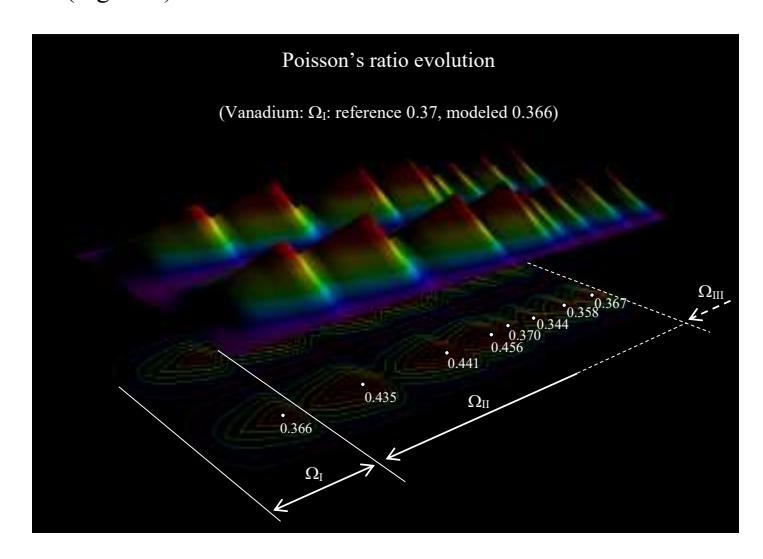
Also, as the procedure for verification and calibration of modeled quantity, the prior and posterior probabilities were used. The averaged value of Poisson's ratio related directly to number of resonances (or superposed quantum jumps) was used as the controlled physical characteristic influenced by geometrical heterogeneity of bcc-lattices.
It was assumed that full event set $\Omega$ consists of events $H_1, H_2,..., H_n$ that satisfy number of transformations of differently oriented microstructures. Then Bayesian equation looks like
$$P(H_i|w_i) = \frac{P(H_i)P(w_i|H_i)}{P(H_1)P(w_1|H_1)+P(H_2)P(w_2|H_2)+...};\tag{1}$$here $i=\overline{1,N}$, $P(H_i)=\frac{N_{wi}}{N}$, $N_{wi}\in Q$, $Q=\{N_{wi},...N_{wn}\}$, $P(w_i|H_i)$ is prior probability influenced by modeled number of transformations of event $w_i$ according to the chosen objective function $f_N(Q)$ and one assesses relative accuracy of simulated Poisson's ratio $P(w_i|H_i)=\frac{v(w_i)}{v}$, if $v(w_i)< v$ and $P(w_i|H_i)=\frac{v}{v(w_i)}$, if $v(w_i)> v$. Simulated results demonstrate some disagreement between prior and posterior probabilities. It means that chosen number of features with various lattice directions is not enough because of other physical character inside the atomic structure.