
Thin-film solar cells (SC) are attractive due to their low fabrication costs, which mostly depend on the costs of the raw materials of the compounds. We have investigated thin film FTO/V2O5-x/i-a-Si:H/LiF/Al samples. The deposition technology was based on RF magnetron sputtering, PECVD and thermal evaporation [1] which are optimal for the cheap, fast and relatively low temperature production. Moreover, there are no toxic elements involved in the manufacture process; this makes these SC even more advantageous. However, hydrogenation is associated with light-induced degradation of the material, called the Staebler–Wronski effect. [2] Though the efficiency of a-Si:H solar cells is still relatively low as compared to poly-Si cells, but their energy payback time is much shorter. [3]
The aim of this research was to evaluate photoelectric properties of the thin-film solar cell samples with different intrinsic layer i-a-Si:H thicknesses at 300, 340 and 460 nm. Their thermal activation energies EA, short-circuit currents ISC, open-circuit voltages UOC, fill factors FF and characteristic resistances RCH were evaluated by measuring current-voltage (IV) dependencies at different temperatures ranging from 80 to 320 K upon 455 nm light illumination.
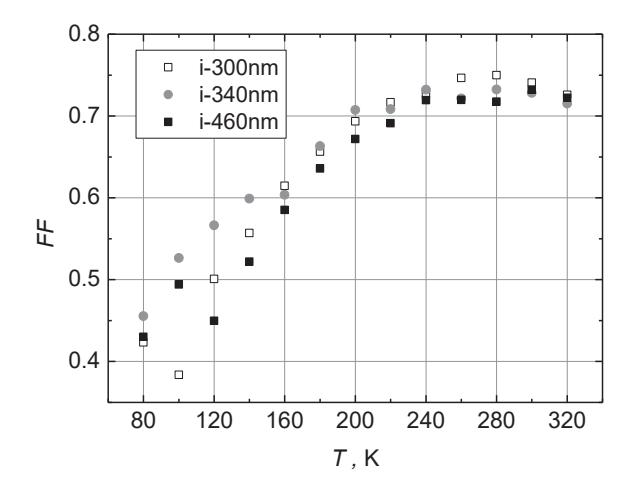
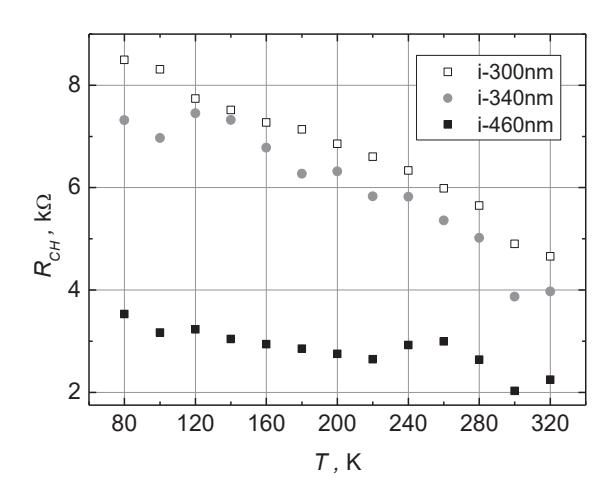
Short-circuit currents ISC used to decrease slightly at lower temperatures, while the best results of ISC were observed in the samples with the widest intrinsic region i-a-Si:H=460 nm. Open-circuit voltages UOC did not vary as much, indicating that the characteristic resistance RCH was much lower in these samples. UOC used to increase at lower temperatures, while FF were noticeably reduced below 200 K. Steady growth of RCH was observed while lowering the temperatures.