
State-of-the-art OLED devices are fabricated using phosphorescent or triplet-emitting materials. OLEDs based on singlet emitters utilizing thermally activated delayed fluorescence (TADF) phenomena offer an alternative technology, which can also deliver internal quantum efficiency of unity. This allows to reduce the cost and increase operation lifetime of an OLED. TADF is a thermally-assisted process, which enables triplet state harvesting with an efficiency of 100% via reverse intersystem crossing (RISC) to singlet manifold. [1] For the RISC process to be efficient, the energy gap $\Delta E_{ST}$ between $S_1$ and $T_1$ excited states must be small, i.e., $< k_B T$. This can be achieved by designing emitter molecules with spatially separated donor and acceptor moieties resulting in small overlap of HOMO and LUMO. However, since the separation weakens oscillator strength, and so the quantum efficiency of the optical transitions, a balance must be found. Thus, optimization of new TADF compounds and OLED structures taking into account this balance is a primary task in OLED research.
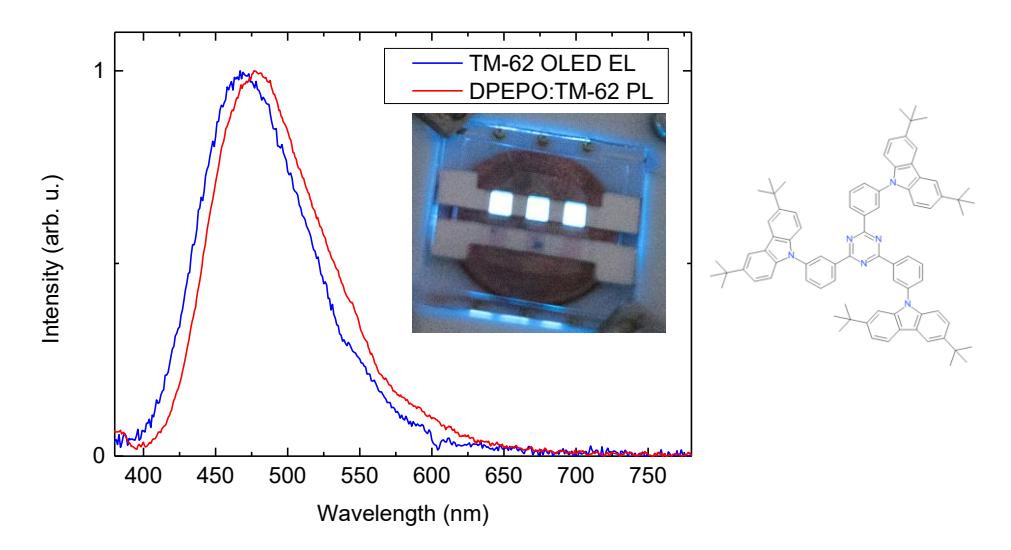
In this work, properties of OLEDs based on triazine TADF compounds are investigated. Spatial separation of donor and acceptor moieties in the compound ensures small HOMO-LUMO overlap, resulting in a small $\Delta E_{ST}$. For triazine compound TM-62 $\Delta E_{ST}$ was found to be as small as 0.12 eV. Luminescence lifetime measurements revealed delayed fluorescence component with a lifetime of 80 μs. The PL quantum efficiency of the DPEPO:TM-62 emission layer was found to be 9% in oxygen-free atmosphere. This should result in a maximal external quantum efficiency (EQE) of 2% in the OLED based on this emitter (Fig. 1). However, a somewhat lower EQE was obtained. Additionally, the fabricated OLED showed an irregular I-V curve most likely due to the poor charge injection from the electrodes and non-optimal layer thicknesses. The current results prompt for further device optimization.