
Y3Al5O12 is commonly called yttrium aluminium garnet (YAG) and adopts the cubic garnet structure. Rare earth element doped YAG has been thoroughly investigated for application in various fields, such as lasers, scintillators, cathode ray tubes (CRT), field-emission displays (FEDs), plasma display panels (PDPs,) and optical windows, due to its attractive optical properties, outstanding chemical stability, low creep rate and high thermal resistance1,2,3,4. Luminescent materials based on YAG are stable under conditions of high irradiation with an electron beam5,6.
Luminescent materials containing europium (Eu3+) and samarium (Sm3+) ions have attracted a special attention during the past decades for their superior optical properties such as narrow emission bands for high colour purity, high quantum efficiency, large stokes shifts and long life time. These materials have important applications in the display field due to their excellent fluorescence properties in the visible region7.
In this work YAG samples doped with different amount of Sm3+ and Eu3+ were prepared by sol-gel method. To our best knowledge, YAG:Sm,Eu garnets with various doping levels of europium have not been synthesized yet. Therefore, the main aim of this study was to fabricate these garnets and investigate their structural properties.
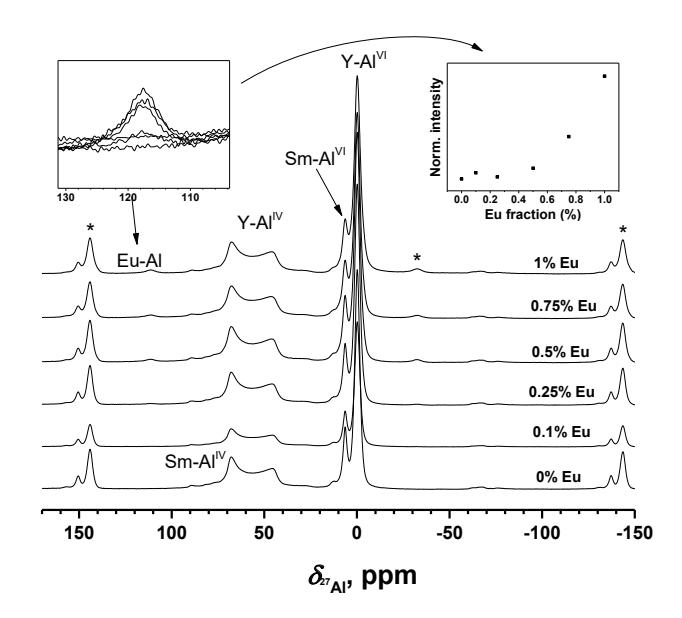
Photoluminescent properties of YAG:Sm,Eu materials are largely determined by the local environments of Eu3+ and Sm3+ ions. In non-doped Y3Al5O12, yttrium cations reside in the dodecahedral interstices formed by the network of corner-sharing AlO4 and AlO6 polyhedra4,8,9. Since it is expected that the Eu3+ and Sm3+ ions will occupy the same dodecahedral interstices, the local environment of these cations could be inspected by solid-state NMR spectroscopy, which uses NMR-active 27Al nuclei as local probes. Peaks of AlIV and AlVI with samarium and yttrium in their vicinities increases increasing doping element. A simple calculation of expected aluminium intensities based on probabilities for a normal distribution shows a very nice agreement with the experimentally detected intensities and thus reveals that the Sm3+ ions are randomly dispersed throughout the crystal lattice of YAG:Sm,Eu (Figure 1). The linear relation between the Al(1Eu) line intensity and the Eu3+ indicates that, as for samarium, the spatial distribution of europium ions in these samples is also homogeneous.