Grafting of artificial tissues and/or biomaterials into patients instead of transplantations from organ donors has become a vivid research field and a promising clinical strategy. Likewise the donated grafts, (bio)synthetic tissues can restore/replace the functions of lost organs, thus saving patients' lives or improving their quality of life. However, this strategy has been suffering from material-related issues such as toxicity, inflammations, rejection and other failures.
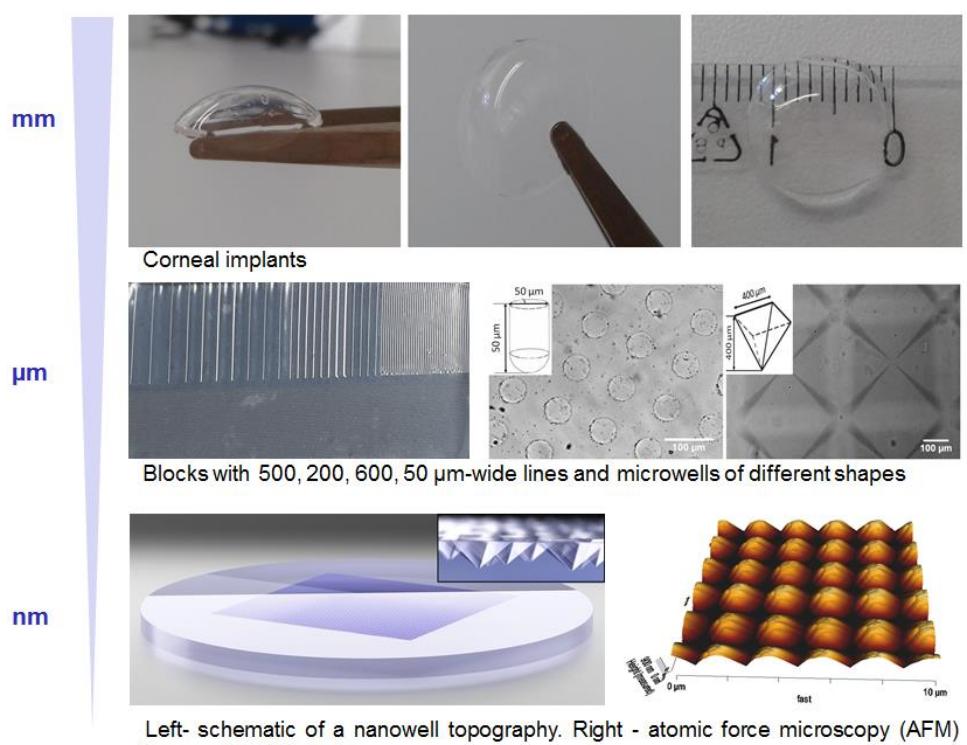
Artificial tissues that are nowadays produced in laboratories consist of cell networks that are grown within a 3D matrix. Biosynthetic collagen hydrogels [1] combined with micro/nanofabrication techniques create a new powerful platform for LEGO-like assembly of tissues and organs. Therefore, in the present work, we have explored fabrication of collagen-based, tissue microenvironments that enable proliferation and differentiation control and programing of different cell types. Namely, we have micromolded porcine collagen-based hydrogels to obtain groove/ridge textures, well, pyramid and other surface features, with a precision down to 50 nm. We have employed them as scaffolds that allowed us to control cell culture (e.g. human corneal epithelial cells, skin fibroblasts, skin epithelial cells, and mesenchymal stem cells) in 3D, as well as to combine different cell types. Our proof-of-principle study indicate that the developed toolbox is suitable for tissue-mimetic cell cultures, spatially defined co-cultures and as well as for artificial tissues in cell biology, high-throughput screening and regenerative medicine applications.