
Dispersion of different nanoparticles (NPs) has attracted attention of many researchers to improve electro-optical properties of liquid crystals (LCs) in recent years [1-4]. In the present study, we carried out a complex research of the effect of modified detonation nanodiamonds (DND) on electro-optical characteristics of NLC. Nanodiamonds are unique carbon NPs because of their intrinsic hydrophilic surface. The surface contains a complex array of chemical groups, including carboxylic acids, esters, ethers, lactones and amines. Alteration of DNDs surface can lead to a bunch of chemical properties, which can be compared with nanoscale diamond powders, since almost 15% of all atoms in the DND primary particle are located on the surface and, therefore, can dissolve. DNDs show potential for applications in energy storage, composites and catalysis. Besides, DNDs can be used in electroanalysis, electrochemical doublelayer capacitors and batteries. Other potential is biomedical applications including usage of nanodiamonds as supporters for solid-phase peptide synthesis and as sorbents for detoxification and separation.
To modify the structure of detonation nanodiamonds (DNDs) several carboxylate groups were added to DNDs. Activation of COOH-surface functionalized groups allowed attaching of various organic tails to molecules. It was investigated that dielectric and electro-optical properties of nematic liquid crystalline mixtures (LCMs) doped with modified DNDs (MDNDs). For the LC base two mixtures with different polar liquid crystalline compounds were prepared. M-1 is the mixture based on the compound with the NCS end group, M-2 is the mixture based on the compound with the CN end group (50%) and F atom (50%). The conglomerates based on 4-octylphenyl DNDs with a size of about 50 nm led to N-4. 0.5% of N-1, N-2, N-3, N-4 were added to the mixtures M-1 and M-2, leading to NLH-1, NLH-2, NLH-3, NLH-4 and NLH-5, NLH-6, NLH-7, NLH-8, respectively.
We demonstrated that the influence of DND on mesomorphic, dielectric and electro-optic properties of LC depends on the size of NPs and the type organic molecules grafted to DND. It was found that NPs of a small size (5-6 nm) do not significantly affect on the parameters of LCMs. At the same time conglomerates of a larger size (50 and 100 nm) depending on the tails polarity can increase or decrease the dielectric anisotropy and response time of LCMs in about 1.2-1.4 times.
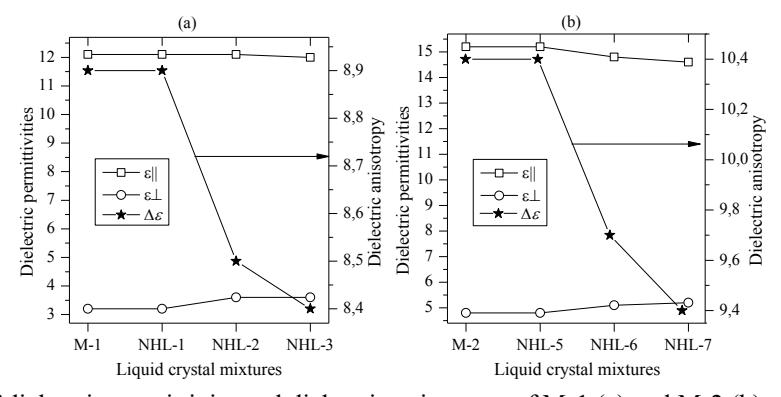
To test the impact of such NPs on the parameters of compositions based on compounds with different polar groups compositions based on compounds with the isothiocyanate polar group (NCS) and with cyano group (CN) and F atoms were investigated. DNDs of various doping concentrations were dispersed in NLCs cells. The dependence of mesomorphic, dielectric and electro-optic properties of LCs on the NPs size and a type of organic molecules grafted to DNDs was shown. The grafting of polar fragment (dicyano-4-4'-biphenyl) to DND leads to increasing of dielectric anisotropy and switching time while non-polar fragment (4-octylphenyl) grafted to DNA leads to decreasing of listed properties. The change of the dielectric anisotropy and switching time is caused by the increase of the amount of DND particles.