
Sillenite crystals (bismuth silicon Bi12SiO20 (BSO) and bismuth titanium Bi12TiO20 (BTO) oxides) are quite complex materials exhibiting piezoelectricity, optical activity, photochromism, photoconductive and electro-optic properties. One more property of electric current generation has already been explored under continuous and pulse illumination and it has been connected with the non-uniformity of radiation beams[1,2]. The aim of the paper is experimental description of the photoelectric-emf with changing the polarity under transverse-moving nanosecond pulse illumination with 532 nm wavelength and 10 Hz repletion rate.
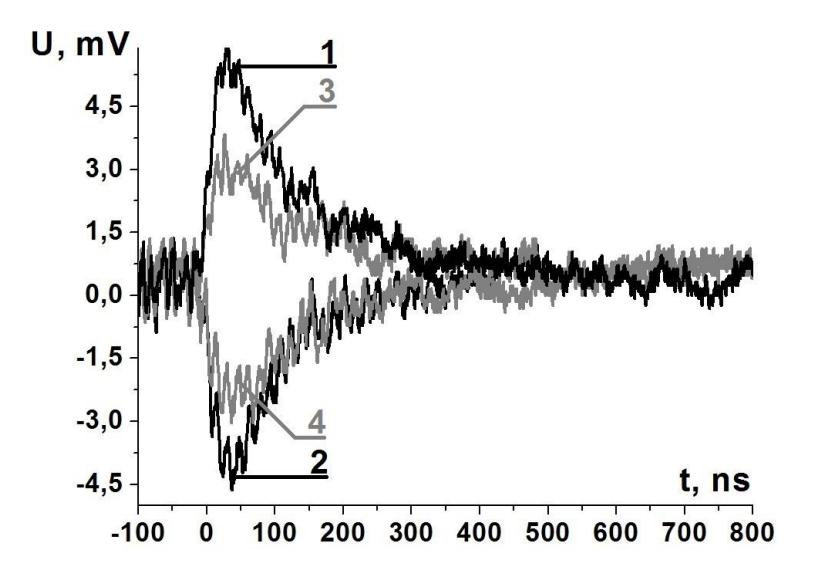
Electrical scheme of experiment include load-circuited sillenites using digital oscilloscope to record photoelectric signals under pulse illumination. Amplitude of such signal signal achieves tens of millivolts on the 550 Om load resistance (fig. 1) and increase with laser intensity increasing. It should be mentioned that in semiconductor crystals photovoltage signal can't exceed the width of the bandgap. The width of bandgap in sillenite crystals is about 3,5 eV. Because of the sillenite crystals haven't the center of symmetry the polarity of observable photovoltage signal varies with the direction of motion. So on figure 1 the first and the third curves correspond to the shift of pulse illuminating stripe in one direction; the second and the fourth curves correspond to the same shift in opposite direction.
Intensity of laser radiation is not only one parameter which influence on the amplitude of signal. As amplitude of recording signal decreases as duration of laser exposure increases. There are black curves (1 and 4) and gray curves (2 and 3) on figure 1 to compare peak value of photoelectric signal immediately when the laser is just switched on, and a few minute later.
Obtained results demonstrate that sillenite crystals are very prospective for development on their base different devices of optoelectronics.