
Atmospheric aerosols have a substantial impact on the global climate and human health. Biogenic secondary organic aerosols (B-SAO) constitute a significant part of the atmospheric aerosols. B-SOA can be formed in the atmosphere upon oxidation of a number of biogenic volatile organic compounds (BVOC). Such ecosystem like forest is the main source of the BVOCs and in the global scale their emissions are higher than anthropogenic VOC (Misztal et al., 2015). In order to understand which B-SOA emissions from plants are related to the heat, the chemical composition of aerosol particles were investigated. The measurements were performed applying the Aerosol Chemical Speciation Monitor in the forested environment of Lithuania between 2013 and 2016.
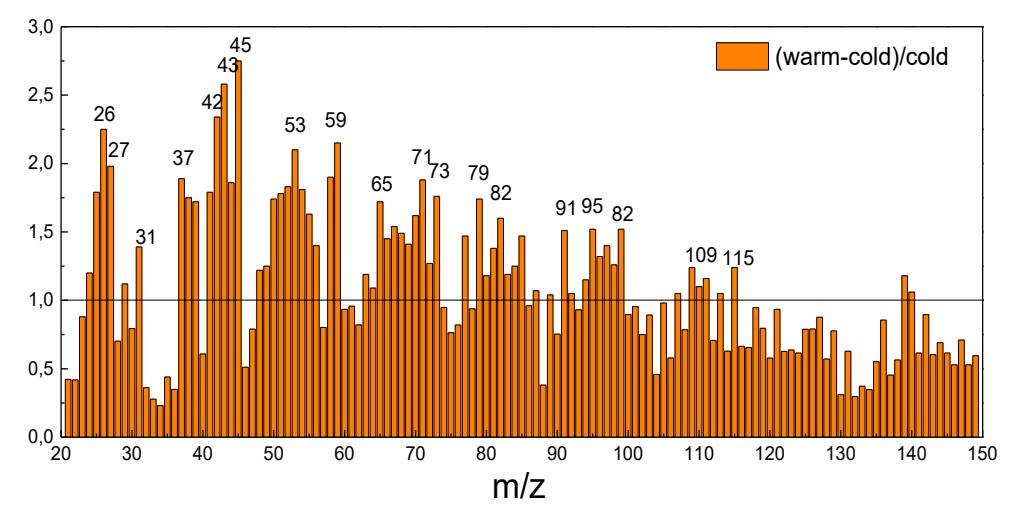
Days characterised by clean air masses and the domination of semi-volatile organic compounds were selected and divided into warm and cold periods (average daily temperature was 17.4 °C and 6.9 °C respectively). It should be noted that the distinction of average mass spectrum during warm and cold periods was normalized. As the result, a great temperature dependency was established – the signals of m/z 45 and 43 were more than 2.5 times higher during the warm period than during the cold one. Additionally, the normalized distinction of m/z 26, 27, 37, 42, 53, 59, 65, 71, 73 79, 82 was greater than 1.5. Moreover, for the selected days the submicronic forests organic aerosol mass (SFOM) analysis was performed. The SFOM concentration was 4 times greater during the warm period than during the cold one (4.7 and 1.2 μg/m3 respectively). The average diurnal plot of SFOM concentration reached the maximum value during the night (from 20 to 8h). Furthermore, the SFOM concentration dependency on temperature was found to be increasing exponentially. Thus, a clear temperature dependency was established for several m/z signals and SFOM concentration. All the above could lead to the expanded understanding of the forest ecosystem.