
Activated carbons are effective sorbents, as they can be characterized by their large surface area, high porosity, great adsorption capacity. Other applications include using AC as storages and catalysts.
Nowadays regenerating AC is problematic, so from the commercial point of view synthesizing AC from renewable source seems as a perspective. Different kind of agricultural, industrial and animal wastes, as long as polymers were tried as the source for the production of AC.
The synthesis of AC is a complex procedure with many variables [1]. Most of the synthetic plans consist of two stages: carbonization, at which raw materials are being heated up to 800°C to produce char and activation - to obtain high porosity and surface area. AC can be synthesized by physical or chemical methods. The main difference is upon using activating agent - CO, CO2 or steam in physical process and chemical where alkalis and salts are used to activate carbon.
Despite the amount of publications, it is hard to say that the process is well studied. Dependent on the carbonization and activation temperatures, temperature rates and procedure time, concentrations and the nature of activators and raw materials, not speaking about the atmosphere and the flow rate — the result may significantly vary. The following parameters are independent and differently affect, dependent on other parameter values, on the final product characteristics.
An interesting decision here might be using artificial neural networks (ANNs), as the problem can be considered not formulated [2]. A great amount of input information from scientific articles allows to train the network for certain popular carbon precursors. The application of ANN allows to model above mentioned procedures, what can result in achieving effective methods for activated carbon synthesis. An example of the ANN for activated carbon synthesis can be shown on Fig. 1.
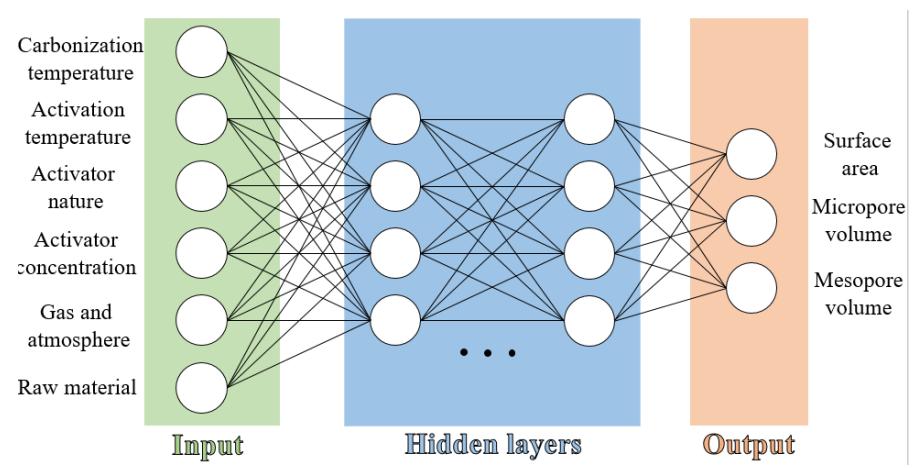
The number of input factors on Fig. 1 are combined into groups: carbonization temperature (temperature and rate), activation temperature (temperature and rate), activator's nature (cation size, iconicity, hygroscopicity, etc.), activator concentration, gas and atmosphere (nature and flow), raw material (element percentage, structure parameters, etc.). The optimal number of hidden layers and neurons is to be found. Three outputs were chosen, as most describable in literature. For commercial proposes the forth output 'yield' can be described.
The described neural network allows better understanding of the processes of activated carbon production, as the suggested experiment performed, have shown significant growth in surface area and micropore value.