Femtosecond laser micromachining is a quick, precise and flexible procedure. Over the past decade, this technique has been used in a broad range of applications and has been progressed considerably. Laser micromachining related with ablation can benefit from laser-induced breakdown spectroscopy (LIBS) and lead to an insight of the instant characteristics or quality of the micromachining [1]. Double or multiple pulses are used to improve the analytical performance of LIBS and to increase the ablation rate in laser material processing [2].
In this report we present results on the application of the multiple pulse LIBS in monitoring of the micromachining process. The soda-lime glass sample was processed with femtosecond high repetition rate (60 kHz – 1 MHz) pulses. A thin (<1 mm) water layer was applied on the surface of the glass sample. By focusing powerful (energy >30 μJ) femtosecond pulses through a low NA objective, self-focusing and nonlinear absorption phenomena transform the beam to a filament which enables more efficient ablation compared to the conventional focusing in air. It results in high micromachining quality due to additional spatial shaping of femtosecond pulses, cooling and cleaning features of the covering water [3]. This method was successfully applied for fabrication of complex objects from transparent, semiconductor and metallic samples. The experiments were carried out using the Yb:KGW laser system with pulse duration 300 fs and power up to 5 W at 1026 nm wavelength, galvanometric scanner and f- theta lens (f = 100 mm). The interferometric system combined with F-theta lens was used for the formation of multiple femtosecond pulses with decreasing energy. The emission from ablated materials was collected through f- theta lens, scanner and taken away at dielectric mirror used for direction of the laser radiation. The strongest emission line in the spectrum of analyzed soda-lime glass was monitored by single pulse and multiple pulse LIBS.
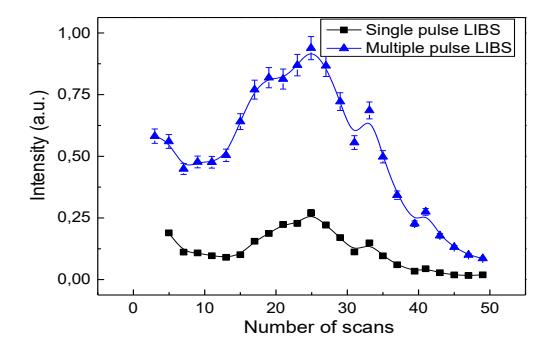
Figure 1 shows the comparison between single pulse LIBS and multiple pulse LIBS signals from processed soda lime glass in dependence on the number of scans. LIBS signal was estimated during the laser processing using various scanning algorithms, processing speed, focus positions, pulse energies and delay time between the pulses. The correlation between the processed groove volume and LIBS signal was evaluated. In conclusion, by using multiple pulses the improvements in the ablation efficiency and in corresponding LIBS signal were observed and some correlations in the multiple pulses LIBS signal can be used for the implementation of laser processing monitoring.