Tl1-xIn1-xIVAxSe2 compounds might be promising materials for the engineering of radiation detectors of different radiation types, ranging from neutron to gamma rays. Applications for solid state optical devices may also be considered. This group of alloys has not been extensively studied, so its properties are not fully analyzed and understood yet. The objective of this work was to study photoelectrical properties of these compounds.
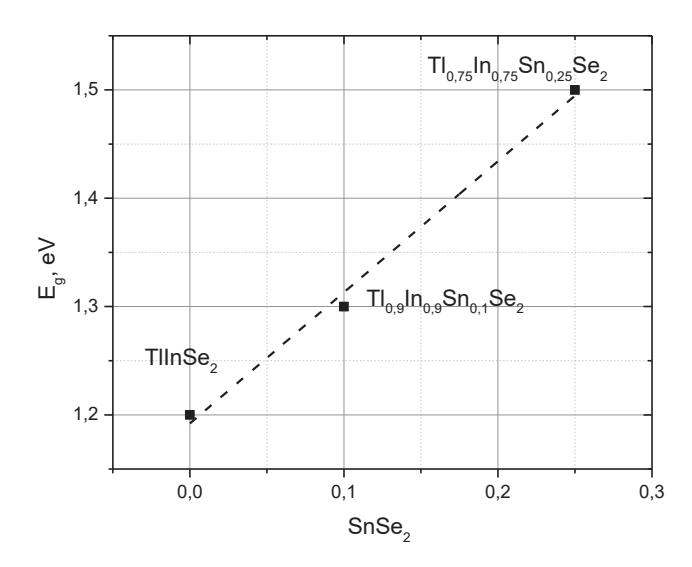
Four samples with different composition were analyzed (Tl0.75In0.75Sn0.25Se2, Tl0.9In0.9Sn0.1Se2, Tl0.8In0.8Si0.2Se2, Tl0.9In0.9Si0.1Se2). We have concluded that the space charge limited currents with a notable influence of trapping states take place in all samples. The samples of Tl0.9In0.9Sn0.1Se2 and Tl0.9In0.9Si0.1Se2 were proved to be the single crystalline ones, meanwhile others were, most probably, two-phase materials with the 'fingerprints' of both SnSe2 and SiSe2. We have determined that bandgap of TlInSnSe2 increases linearly (Fig.1 and Eq.1):
$$E_g = 1.2eV + (1.2 \pm 0.1)eV \cdot x \tag{1}$$depending on SnSe2 concentration and that in TlInSiSe2 it does not. Increase of SiSe2 up to 20% results in a bend of the valence band thus resulting in an indirect bandgap. Our studies show that excess carriers recombine via several recombination channels, having different recombination time constants that depend on temperature and vary depending on material composition. From the analysis of the Thermally Stimulated Currents (TSC), we have shown that shallow traps are present in the crystals.