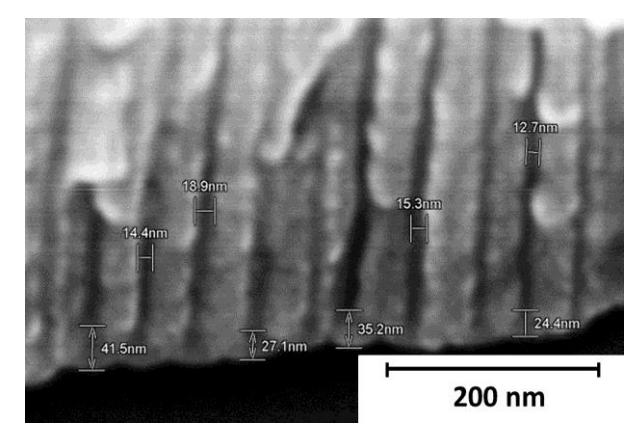
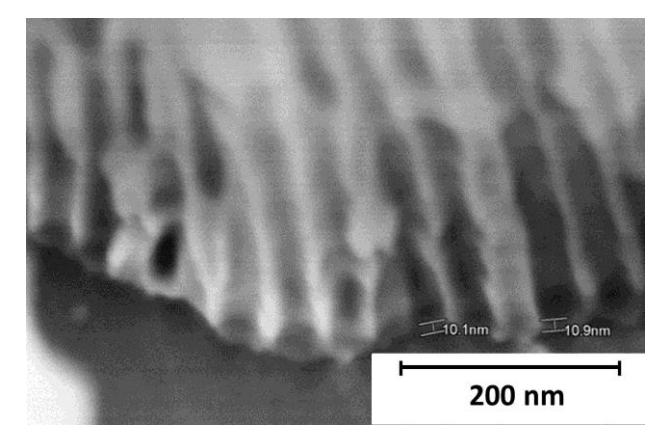
Anodic aluminum oxide (AAO) template has gained increasing importance in recent years due to its potential industrial and technological applications for nanometric device fabrication. Highly ordered nanopores offer the possibility to use AAO as a template for the formation of nanostructured materials, including nanotubes and nanowires [1]. AAO is usually formed as a result of an inexpensive self-organized two-step anodization of aluminum in various acidic solutions [2]. Reduction of expenses associated with using pure aluminum in anodization process can be achieved by AAO formation on cheaper low-purity aluminum alloy. Still in both cases the non-conductive barrier layer after anodization hinders the electrochemical growth of nanostructures and should be thinned. In this present work the thinning of the barrier layer of AAO membrane produced on AA1050 alloy in 2 M sulfuric acid solution have been performed. It was observed that the treatment of barrier layer is highly correlated with the temperature and time. The treatment of AAO template in this media under potentiostatic mode ($E = -0.85$ V) permits control of thickness of the barrier layer by changing temperature from 20 to 60 °C. It was found that higher temperature promotes the reaction of dissolution and barrier layer can be reduced from approximately 26 nm (before treatment) to 12 nm at 30 °C. At higher temperature the destruction of nanopores has been noticed. Additional treatment time research has need performed in order to establish a good reproducible control over the dissolution rate of the non-conductive barrier oxide layer of AAO nanotemplate. The results indicated that with increasing the treatment time from 0 to 30 min the barrier layer can be thinned up to 10 nm. With further increase of treatment time the thickness of barrier layer does not change significantly and after the exposure for 60 min in 2 M sulfuric acid solution at 30 °C the structure of nanopores was destroyed.