
Holographic lithography (HL) is a tool offering capabilities to pattern periodic structures with feature sizes from a few μm down to few nanometers and does not require a photomask [1]. Among its advantages are simplicity of the setup and high possible throughput. These features make this technique appealing for certain applications. The patterns may vary only within the limitation of the interference result obtained with certain laser beam arrangement. More complex patterns can be achieved only by using multiple exposures combined with sample rotations. In this work we attempt to experimentally and theoretically demonstrate the polarization influence on the 2D periodic structures patterned employing a multiple beam HL setup.
Proposed multiple beam interference field intensity calculation algorithm enables estimation of the interference patterns in 3D space where all interfering beams overlap. Moreover, it enables calculations with any kind of linear polarization vector angle of each beam, also takes into account the intensity distribution of the individual beams (e.g. Gaussian), evaluates that interference might take place in the corresponding refractive index material (e.g. photoresist) and even addresses the Fresnel reflections from the substrate or antireflective coating underneath. The minimal energy density, necessary to write in the photoresist can be selected based on the intensity threshold that is imposed on the simulation results.
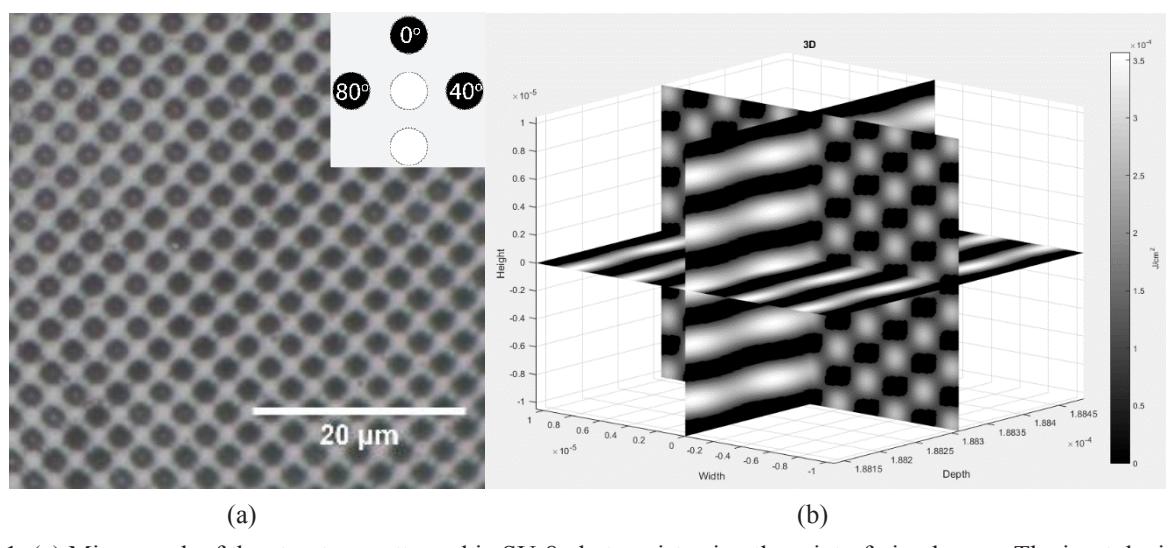
Using the HL setup and selecting different arrangements of the interfering beams together with their polarizations we were able to define periodic 2D structures in SU-8 negative tone photoresist (Fig. 1 a). The laser beam is split into multiple beams using a diffractive optical element (DOE). 4f optical system is then used to focus the beams on the sample. Within the 4f system there are two half-wave retarder plates that allow us to rotate the linear polarizations of the individual beams. Finally, slightly in front of the sample there is a metal plate mask which allows to select the beam arrangement from 2-5 beams by blocking the apertures with magnetic strips.
With the aid of computer simulation we can predict the intensity distribution outcomes of many different beam arrangements and expand the range of structures we are able to pattern (Fig. 1 b).