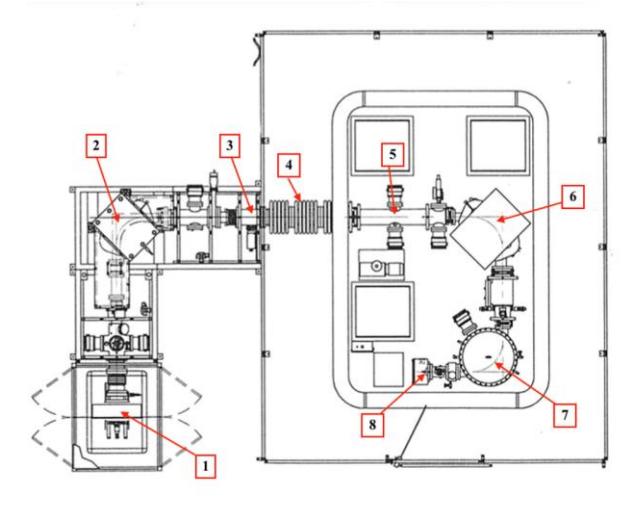
In January 2016, a single stage accelerator mass spectrometer (SSAMS) from National Electrostatic Corporation (NEC) [1] was installed at the Center for Physical Sciences and Technology. It is the first AMS instrument in Lithuania able to determine the ratio of 14C/12C. Fig. 1 shows the principal scheme of the machine, which is equipped with one ion source, 240 kV accelerator stage, a gas stripper, two high energy magnets and a detector built on a high voltage deck inside the Faradays cage. The detection limit of the equipped instrument is 53000 years. After a successful start the accelerator mass spectrometer opens many opportunities in the environmental research, elaborates Lithuania's history facts, and serves in the medicine research.
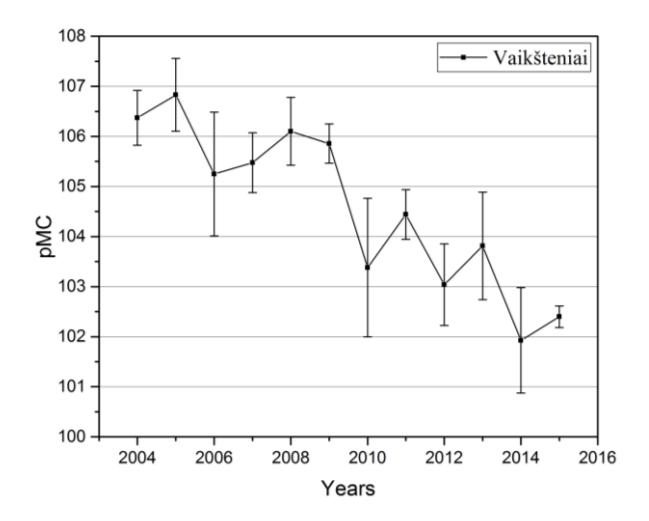
First results measuring 14C activity in the tree rings of Pinus Silvestris are presented in the Fig. 2. Wood cellulose was extracted prior to 14C analysis [2]. From these results we can observe that 14C activity is decreasing over the investigated period. Further analysis will be performed to evaluate 14C activity in the tree rings of XX century.