
Highly luminescent nanocrystals (NCs) are considered to be attractive materials for a variety of applications in biological assays and detection platforms. Since, NCs are fabricated by using high-temperature methods, post-synthetic treatment is necessary to obtain water-soluble nanoparticles (NPs). The encapsulation of NCs with an amphiphilic polymer allows achieve high colloidal stability of NCs in aqueous solutions, while polymer side groups enables introduction of functional groups that can be further utilized for conjugation of NPs' with biomolecules and allows one to control hydrodynamic size and surface charge of NPs. The number and exact arrangement of polymer molecules on the surface of NPs, as well as the coverage density, are expected to be important parameters for regulatory requirements and quality control in clinical applications, and strongly influence the colloidal and chemical stability of NPs in a biological environment, their hydrodynamic size and zeta potential (${\zeta}$).
The aim of this work was to quantify the average amount of amphiphilic polymer molecules on the surface of colloidal semiconductor nanocrystals made of different materials, including CdSe, CdS, and ZnSe with ZnS shell, which have different size and shape (spherical (quantum dots) and elongated (nanorods)).
The idea of this experiment was to label amphiphilic polymer poly(maleic anhydride-alt-1-tetradecene) (PMAT) with a controlled amount of fluorescein-based dye as a marker for estimating the number of polymer chains on the surface of encapsulated NCs. The number of polymer chains per single NC was determined through optical absorption of the dye and NCs.
According to the obtained results, the number of polymer molecules attached to the surface of nanocrystals grows linearly with the surface area. At the same time, the surface area per single monomer (MAT) unit or equivalent average surface concentration of MAT units exhibits highly nonlinear character, because of the increased competition between PMAT molecules for surface binding sites. On the basis of experimental data we also proposed the model for the arrangement of PMAT-molecules on the surface of NCs of surface area (i.e. different size).
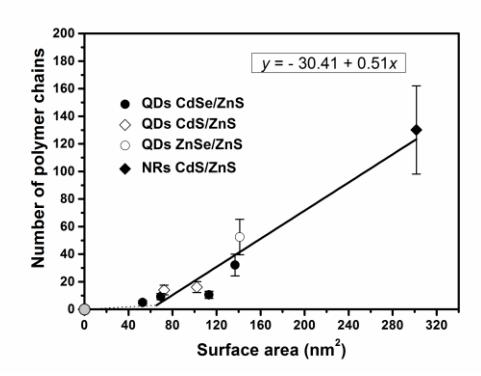
Since zeta-potential (surface charge) of NCs is one of the key parameters that determines their colloidal stability, interaction with macromolecules, cell membranes, cell internalization and thus performance of NCs in a variety of biomedical assays, we also examined the influence of PMAT surface concentration on the zeta potential (${\zeta}$) of encapsulated NCs. The average value of zeta potential (${\zeta}$ = - 35 mV) was found to be independent of the size, shape, and chemical composition of NCs at fixed buffer parameters (carbonate-bicarbonate buffer, pH 9.5 and 5 mM ionic strength). Since the surface charge density is proportional to the number of charged groups per unit area, the average value of zeta-potential at fixed buffer parameters can be further used as a reference point for the determination of the number of free carboxyl groups on the surface of PMAT-encapsulated NPs of different size and shape [1].