
Based on DNA the homology, Pseudomonas syringae species is divided into more than fifty pathovars and at least nine different species; however, only two pathovars are clearly attributed to cereal diseases. Basal glume blotch and leaf blight caused by P. syringae pv. atrofaciens and P. syringae pv. syringae respectively, are the diseases of wheat, barley, rye, triticale and oats. These pathovars have been detected in Italy, Germany, Belgium, Mexico, Russia and other cereal-growing countries. Diagnosis of bacterial diseases based on expressed symptoms is difficult, because they can be confused with those caused by some fungi or other abiotic and biotic factors. It is therefore likely that these diseases could be more widespread and important than is commonly thought. P. syringae has not been studied on cereals in Lithuanian before; however, the atypical for fungal injuries leaf spots and glume discolorations have been frequently found recently. The aim of current study was to assess the presence of P. syringae pathovars on cereals in Lithuania.
The isolates of P. syringae used in this study originated from various regions of Lithuania. Samples of leaves, stems, heads and mature seeds of diseased winter and spring wheat, winter triticale, and spring barley plants were collected in 2013-2015. Pure cultures of the selected P. syringae-like isolates were recovered from accumulative onto selective media [1, 2]. The isolates were tested for production of blue-green fluorescent pigment on King's medium B and were used for LOPAT test (levan production from sucrose positive, oxidase reaction negative, pectolytic activity on potato slices negative, the presence of arginine dihydrolase negative, hypersensitivity to tobacco leaves positive) [1, 2]. Based on LOPAT test results to P. syringae assigned strains were evaluated for their pathogenicity to host plants using seedling spray and the leaf injection methods (fig. 1) [2, 3].
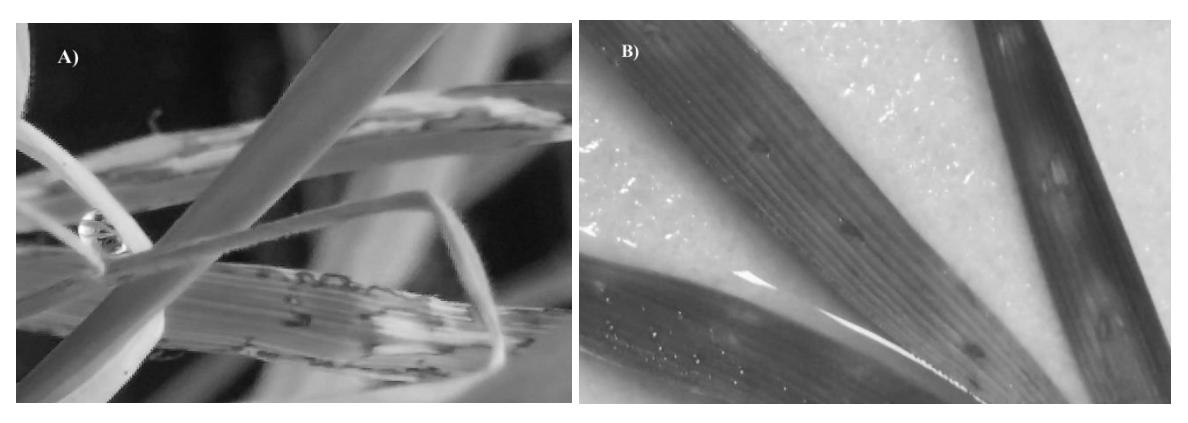
According to the above mentioned features, only 2.4% of all isolated bacteria were assigned to P. syringae [1, 2]. The leaf blight symptoms on seedlings sprayed with bacterial suspension were caused only by half of the selected strains. None of the strains caused dark margins around the injection point, therefore could not be attributed to P. syringae pv. atrofaciens. According to our results, P. syringae poses only minimal threat to Lithuania-grown cereals and it is likely that the environmental conditions in our country are more favourable for the occurrence of P. syringae pv. syringae.