Apart from the obvious practical significance of uranium trioxide, for example in the production and reprocessing of nuclear fuel and uranium enrichment, such a molecule is also of great interest from a fundamental point of view due to its complicated electronic structure and geometry features. For most trioxides the $D_{3h}$ point group is typical. Experimental studies of the molecular uranium trioxide were carried out at high temperatures in the gas phase [1-2], as well as at low temperatures in argon matrix [3]. The last indicated $C_{2\nu}$ point group for the molecule (T-shaped structure with nonequivalent bonds). Ab initio calculations [4] verified $C_{2\nu}$ point group and determined the more symmetrical $D_{3h}$ point group for a saddle point, as an explanation a second-order Jahn-Teller effect was proposed. Computational study [5] showed besides of all mentioned an existence of Y-shaped structure. All the ab initio calculations for the UO3 molecule are performed in single configuration approximation, which is not always reliable. That is why research of the electronic structure using quantum chemical methods of high-level theory is worthwhile.
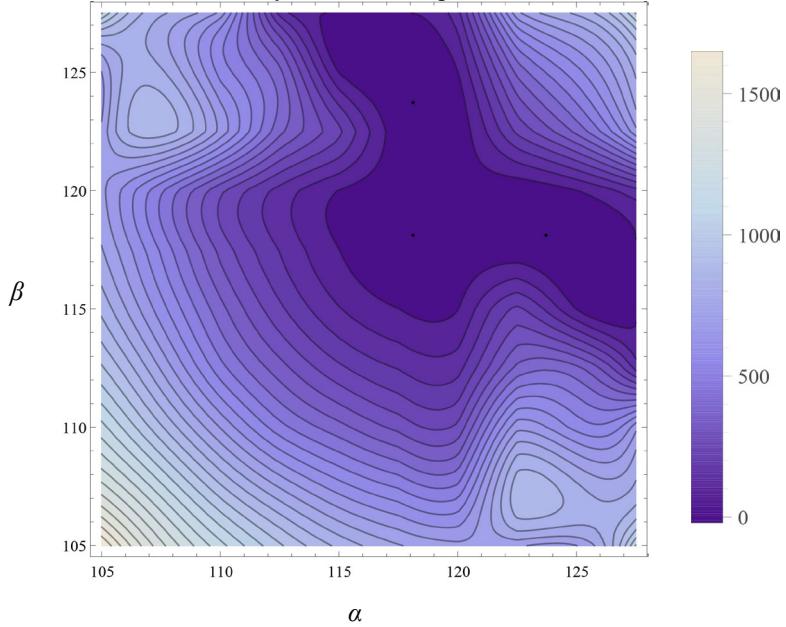
We carry out calculations of potential energy surfaces (PESs) of low-lying electronic states as functions of internal coordinates at the multiconfiguration CASSCF level of theory. The active space for CASSCF calculations included six electrons on eight orbitals. The SA-procedure was done for two states (triplet and singlet). For uranium atom we used Stuttgart large fully relativistic ECP, replacing eighty inner electrons, and corresponding TZ basis set, for oxygen atom we used cc-pVTZ basis set. We firstly determined triplet to be a ground state of the uranium trioxide molecule. The potential energy contour map of the ground triplet electronic state is presented in Fig. 1. The PES of the first exited singlet state has a similar character. The fixed internal coordinates $\alpha$ and $\beta$ are the angles between each of the equivalent bond and the one along the symmetry axis. The PES has tree minima, marked in Fig. 1, at (118.14°,118.14°), (118.14°,123.71°) and (123.71°,118.14°) angles with bond length of 1.90, 2.25 and 2.25 Å and two evident valleys. Energy strictly increases, saddle points do not appear. A symmetrical $D_{3h}$ geometry predicted earlier for the UO3 molecule also absent and a second-order Jahn–Teller effect is not implemented. Thus, for an explanation of geometry of the molecule we provide a lack of electron density to form the equivalent chemical bonds.