
Noble metals nanoparticles with controlled geometrical and optical properties are the subject of intensive studies and materials applications due to thier excelent stability derived from organic monolayer. As a deeply investigated system, they make excellent reference material for studying behavior of larger structures build from nanoparticles. [1][2]
Gold nanoparticles inherit property of LSPR (localized surface plasmon resonance) that makes them interesting subject in field of optical properties of condensed matter materials, particularly metamaterials, SERS (surface enhanced Raman spectroscopy), sensing etc. [3][4] LSPR in nanoparticles can be tuned by a number of features. Starting from nanoparticle shape or size, ending on their spatial arrangement and relative distances between them.

Thermotropic liquid-crystalline molecules manifest property of changing their spatial arrangement and degree of order in material they make. These behaviour can be seen when material of this type change its phase from solid to liquid-crystalline, liquid-crystalline to isotropic liquid or between diffrent liquid-crystalline phases. These changes are tuned by changes of temperature.
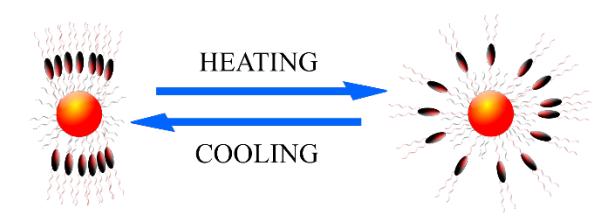
Terminating liquid-crystalline molecules by thiol group allow to utilize them as surface-coating agent. This allows self-assembly of gold nanoparticles into ordered structures in liquid-crystalline manner, therefore offering reliable means of changing optical properties of material given by presence of LSPR. [5]
In this research, small gold nanoparticles in size of 2-3 nm were functionalized with liquid crystal molecules. They were also subjected to procedure causing phenomenon called Anti-Galvanic Reduction. [6] That lead to appearance of strong LSPR enhancemen, that can be dynamically controlled.