Many known advantages of organic light-emitting diode (OLED) displays in power consumption, pixel brightness, viewing angle, response time, and contrast ratio over liquid crystal displays (LCDs) have been driving research and development in this area [1]. A major technical challenge, which prevents their commercial utilization remains the drive transistor in the active matrix (AM) backplane. Organic material based channels are useful due to their homogeneity, low cost, and the variety of deposition possibilities, but they have low electron-hole mobility [2]. During operation, the thin-film transistor (TFT) having low-mobility channel layer would need a large source-drain voltage to drive the necessary current. This consumes more power in the transistor as compared to the light production in the OLED, compromising the power savings. This problem cannot be addressed by increasing the channel width of the drive transistor to increase source current, because it would reduce the fraction of pixel area available to the OLED. It needs a higher current density through the electroluminescent emitter to maintain the display brightness which degrades the OLED [3].
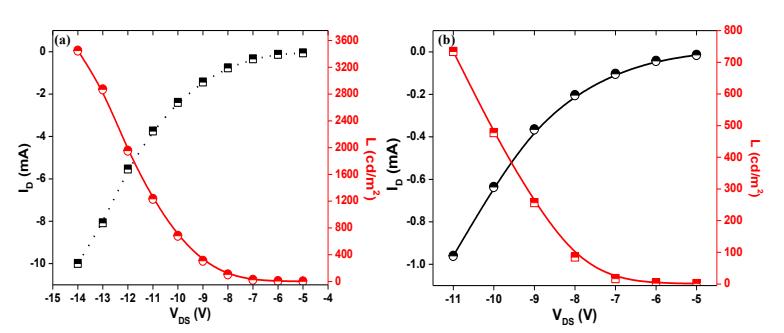
Vertical-type organic light-emitting transistors (VOLETs) have advantage of short channel length without the need of high resolution patterning and provide on-current sufficient to drive OLED pixels at low operating voltages [4]. In this article, An organic light emitting transistor (OLET) with tris(8-hydroxyquinoline) aluminium (Alq3) as an electron transport layer (ETL) and 1% 4-(dicyanomethylene)-2-methyl-6-[p-(dimethylamino)styryl]-4H-pyran (DCM) doped Alq3 was fabricated for studying the light emission behaviour of small molecules. The doping was done to achieve color tuning of emitted light. In this device electrons at source-dielectric interface and holes at ETL-LiF interface create an electric field which reduces the injection barrier at the ETL-source electrode (Al) interface. This electric field helps in the injection of electrons from the source electrode into the organic layer and these electrons recombine with holes injected from the drain electrode at emissive layer (Ir(Ppy)3:CBP) to produce electroluminescent photons. An increased recombination of electron - hole is observed in undoped Alq3 OLET with light emission of ~3500 cdm-2 (510-520 nm) and comparatively less emission of ~750 cdm-2 (600 nm) is observed in DCM doped Alq3 OLET. The results give an insight for the development of next generation small molecule based OLET display technology.