
Nano-size quasicrystalline structures have been a subject of interest over recent years due to their potential use as reinforcement in advanced engineering alloys. The icosahedral phases are hard and brittle due to the difficulty of dislocation movement in the quasiperiodic lattice without long range periodicity [1]. Al-based alloys and, particularly, those containing quasicrystals and related compounds, are of growing attention for researches employed in scientific and engineering applications. Quasicrystalline Al-Fe-Cr-based alloys comprise a number of nano-sized quasicrystalline particles of icosahedral phase (i-phase) dispersed over $\alpha$-Al matrix. That is why excellent balance between a high strength and sufficient ductility is indicative of quasicrystalline Al-Fe-Cr-based alloys compared to commercial Al-based alloys recommended for service under elevated temperature.
Thus, nanoquasicrystalline Al-based alloys are generally performed as semi-products in form of either melt-spun ribbons/flakes or gas/water atomised powders. Because of this the development of processing routes available in view of semi-product consolidation is of great importance for manufacturing the bulk-shaped material and, as a consequence, further improvement of structural stability is desirable to maximize elevated temperature.
This study devoted to investigation of structure and phase composition of the composite quasicrystalline powder Al94Fe3Cr3 alloy consolidated under quasi-hydrostatic compression at different pressures of consolidation.
Consolidation of the powder with particle size of 40 μm was performed by quas-hydrostatic compression. Compacting produced in high pressure cells at room temperature (no heating) under pressure of 2.5; 4 and 6 GPa. Structural characterisation of alloy consolidated under quasi-hydrostatic compression was performed by X-ray diffraction (XRD) analysis using Cu Kα radiation and scanning electron microscopy (SEM).
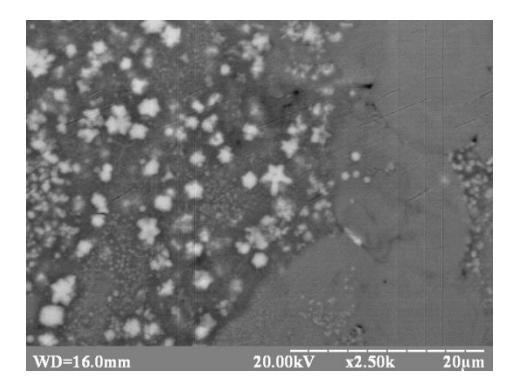
Fig.1 shows the XRD patterns recorded for the feedstock powder, and alloy after consolidation. The presence of diffraction peaks (111) and (200) of $\alpha$-Al solid solution and i-phase, indexed using Cahn's indexation scheme (6.9) (18, 29) [2], is clearly seen for all of the samples. The presence in the alloy quasicrystalline phase (i-phase), embedded in $\alpha$-Al matrix of Al94Fe3Cr3 alloy is confirmed by SEM (Fig. 2).
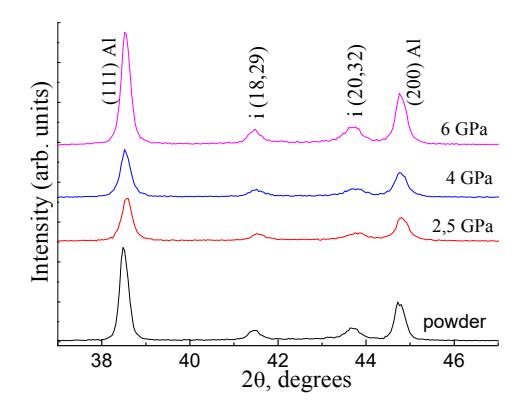
It is important that the integrated intensity of the diffraction peaks of metastable quasicrystalline i-phase in the Al94Fe3Cr3 alloy consolidated under pressure (2.5, 4, 6 GPa) at room temperature is identical to that in the initial phase powder, indicating complete retaining the unchanged fraction volume of QC i-phase safety of its contents in the structure of the material after consolidation in extrusion at 623 K when quasicrystalline phase loss reach the 23% [3].
Superior advantages of the quasi-hydrostatic compression as alternative solid-state consolidation process for structural performance of quasicrystalline alloys by plastic deformation is discussed by comparison with that resulted from currently employed hot extrusion put into practice at the 623 K. As opposed to extrusion process assisted by unidirectional deformation, comprehensive quasi-hydrostatic compression is primary responsible for creating the mostly effective intimate metallic bonding between the adjacent Al-based powder particles under quasi-hydrostatic compression when the temperature was 293 K.