
Nondiffracting Bessel beams are known to maintain transverse shape during propagation in large distances compared to Gaussian beams [1]. Superposition of Bessel beams with different frequencies and amplitudes results in nondiffracting pulses, which can propagate without dispersive spreading in linear dispersive medium and exhibit interesting properties such as superluminal velocity [2]. Vector nature of nondiffracting pulses becomes important when angles of plane waves in angular spectrum become large. Linearly polarized vector Bessel X pulses was introduced in [3] and an appearance of longitudinal and cross-components was observed.
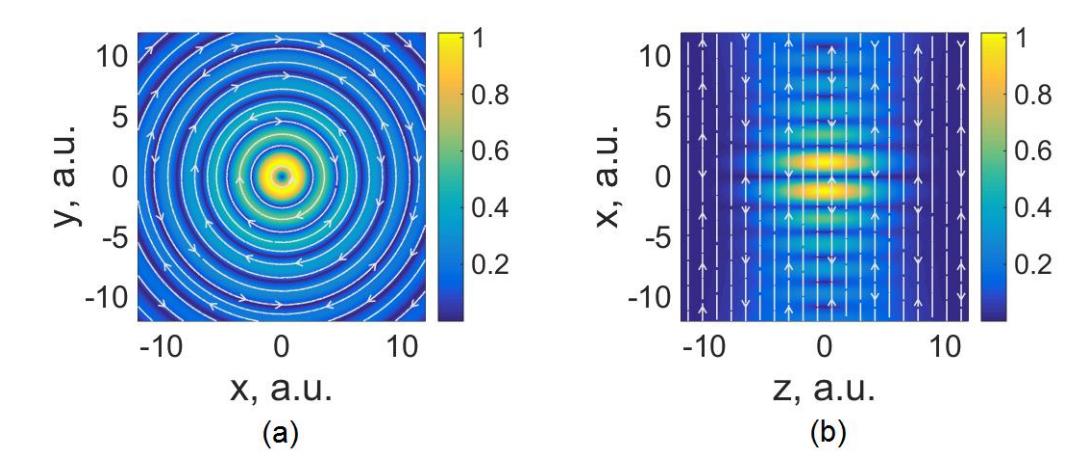
In this work we analyse azimuthally and radially polarized nondiffracting vector Bessel X pulses. Analytical solution of scalar Bessel X pulses with near Gaussian frequency spectrum was used [4]. We obtain vector solutions from the scalar ones using method described in [5]. Electric field in transverse electric mode is always orthogonal to propagation direction of the pulse and represents azimuthal state of polarization. Electric field in transverse magnetic mode points along radial vector and thus in this mode pulses are radially polarized. Properties of obtained pulses with different Bessel cone angles and widths of frequency spectrum were analysed. Vector Bessel X pulses with nonzero topological charge ($m$) are also studied in detail. In case $m=0$, the distribution of electric field of the azimuthally polarized Bessel X pulse is shown in Fig. 1.
Furthermore, radially polarized nondiffracting Bessel pulses have nonvanishing longitudinal component of electric field, which is concentrated at the center of the beam. Relative magnitude of longitudinal component compared to transverse components can be increased by changing the angle of Bessel cone.