
Photochemical water compatible synthesis is a promising route to the formation of nanostructures, especially when it is desired that the products obtained would have catalytic/photocatalytic properties. Light assisted synthesis, if compared to standard chemical approaches, provides advantages of a uniform distribution of the reducing agent in the entire solution and rather mild reaction conditions [1]. Organic compounds, employed in colloidal synthesis, would be able to block a number of active sites of catalytic materials due to the strong interaction with the metal surface and to the sterical hinders, thus leading to the loss of catalytic activity to a great extent [2]. The proposed photochemical approach enables to produce semiconductor-silver system without employing organic stabilizers and additives, thus resulting in formation of nanoparticles with "clean", highly reactive metal surface.
In this research, photochemically synthesized CeO2 nanoparticles (NPs) were applied as photoactive compounds in order to generate formation of silver nanoparticles. Irradiation was performed using 40 W low pressure mercury discharge lamp NIQ 40/18 – 45000024 (Heraeus – Amersil, Germany), emitting a spectrum with lines at 185, 254, 313, 365, 405, 436, 546, and 579 nm. Irradiation of deaerated CeO2 suspensions in the presence of AgNO3 resulted in the rise of a strong band with the maximum at 393 – 422 nm in the absorption spectra of the solutions, indicating formation of small metallic silver particles.
Faster formation of Ag NPs with the lower amount of silver being required was observed when ethanol was introduced to the reaction solution before the irradiation. Alcohols with $\alpha$-hydrogens are known to easily form $\alpha$-hydroxyalkyl radicals upon $\alpha$-H atom abstraction. Hence, reductive reactions can be strongly enhanced in deaerated ethanol containing solutions with respect to the pure aqueous media.
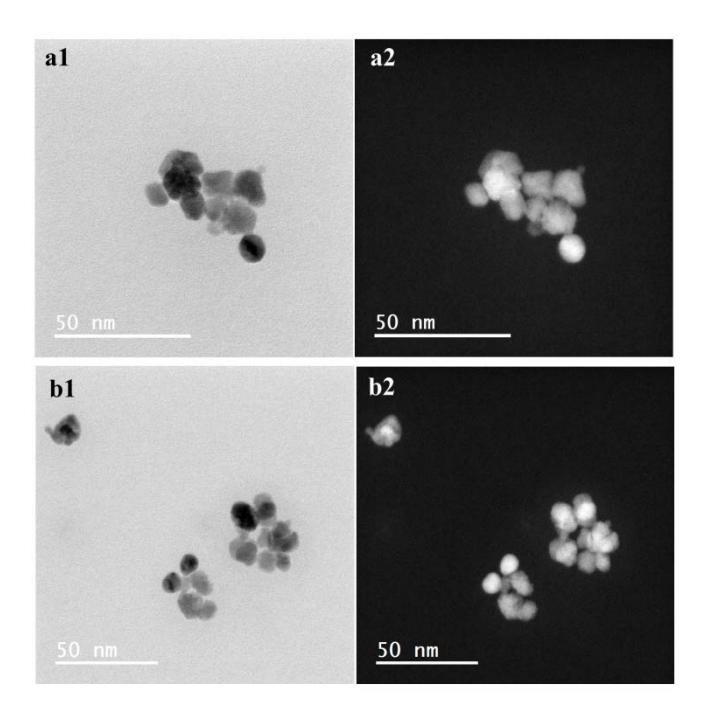
Not only was the overall efficiency of the process remarkably increased by the use of alcohol, but also smaller and more uniform silver nanoparticles with a size comparable to that of ceria nanoparticles (around 15 nm) were formed with regard to those synthesized without radical scavengers as revealed by TEM analysis. Moreover, there were no signs of particularly small Ag NPs, nor were observed large silver nanoparticles, formed separately from ceria, which were present in the samples with higher silver concentration.