Group-III nitrides are very promising materials for solid state lighting, high power electronics and even photovoltaics. It is preferred for nitride epitaxial layers to be grown on native substrates. However, native ones are still very expensive, thus nitrides are mostly grown on cheaper substrates such as silicon carbide and sapphire. Another problem is the lack of inversion symmetry in hexagonal crystal structure, giving rise to spontaneous and piezoelectric polarizations along c-direction leading to energy band bending and efficiency decrease of LEDs.
Integration of GaN to silicon technology is a promising way for cost reduction of a new device generation. A large difference in thermal expansion between Si and GaN, a mismatch in lattice constant and chemical reactivity must be solved to grow crack free, high quality epitaxial III-nitride films on Si substrates. Growth using rare-earth oxides as a buffer could solve these problems [1]. This study is aimed to develop growth technology of non-polar and semi-polar GaN on Si substrates using Er2O3 as the buffer layer.
In this work GaN growth was performed in a close-coupled showerhead metalorganic chemical vapor deposition reactor (MOCVD). Various parameters such as carrier gasses, temperature, growth starting conditions were varied. GaN annealing was also performed. Grown GaN layers were investigated using scanning electron microscopy (SEM), X-Ray diffraction (XRD) and photoluminescence (PL) techniques.
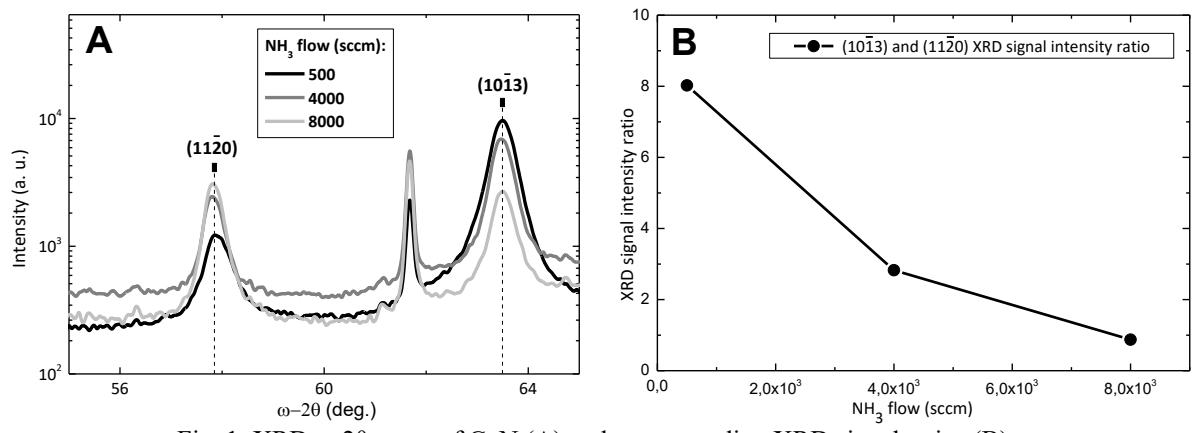
The XRD investigation showed the polycrystalline nature of GaN layers with dominant non-polar (1120) and semi-polar (1013) orientations. More detailed texture analysis revealed that both dominant GaN orientations are formed by growth of {0001} GaN planes parallel to the {111} facets of Si, thus causing the twinning in GaN layers. The domination of semi-polar or non-polar orientation is strongly dependent on Er2O3 (110) in-plane orientation respect to Si (100) wafer off-cut. XRD results also revealed how V/III ratio reduction leads to stronger semi-polar GaN orientation (Fig. 1). SEM investigation of the grown structures showed that nitrogen atmosphere helps to obtain smoother epitaxial layers, while in hydrogen atmosphere islands-like GaN growth was observed. The PL spectra of semi-polar and non-polar GaN showed a near band edge emission including luminescence from the stacking faults. A red shift was observed in spectra due to the expected thermal induced tensile strain in GaN.