Hybrid lead halide perovskite-based solar cells (PSCs) have attracted significant attention in the photovoltaics due to inexpensive precursors, simple fabrication methods, and remarkably high power conversion efficiency (PCE), which already exceeds commercialized polycrystalline silicon solar cells.[1] Typical PSC configurations are n-i-p mesoscopic or planar and inverted p-i-n architecture. The n-i-p configuration devices composed of an electron transporting material TiO2 (ETM), infiltrated with the perovskite absorbing material and coated with a hole transporting material (HTM), which plays an important role facilitating the extraction and transportation of holes from perovskite to the corresponding contact and is essential to reach high light-to-current conversion efficiency. To date, a great number of new promising molecular organic HTMs have been reported, but only very few candidates reached PCE values close to or exceeding 20%.[2] However, although PSCs have achieved high PCE values, the stability remains an issue due to dopant-induced degradation of PSC. [3]
Traditionally, the hole transporting layer (HTL) for PSCs is heavily doped with bis(trifluoromethane)sulfonimide lithium salt (LiTFSI), 4-tert-butylpyridine (TBP), and tris(2-(1H-pyrazol-1-yl)-4-tert-butylpyridine)cobalt(III) tri[hexafluorophosphate] (FK209). TBP is commonly used as HTL morphology controller, while LiTFSI and FK209 provide the necessary electrical conductivity. However, the use of additives is problematic, since hygroscopic nature of lithium salt makes the HTL highly hydrophilic and Co(III) dopant tends to chemical degradation, negatively influencing the stability of the entire device.[4] Therefore, a promising solution for stabilizing PSCs is the appropriate choice of dopant-free HTMs. However, the PCE of pristine HTL based devices are consistently lying around 10%, with only very few examples over 15%. Therefore, development of dopant-free HTMs with both enhanced moisture resistance and charge transporting properties is desired to probe their structure-performance correlations towards the realization of stable and high-efficiency PSCs.
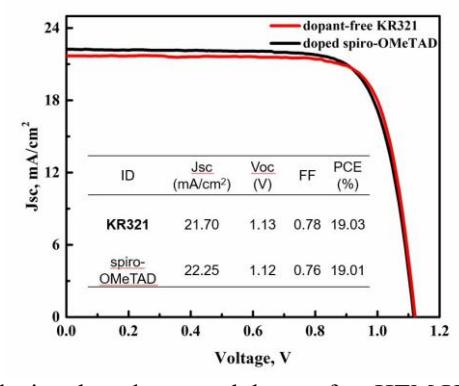
In this work, we have synthesised novel dopant-free star-shaped donor – π-bridge – acceptor (D–π–A) type HTM, featuring a planar triazatruxene central core (D), inducing π-stacking for vertical hole conduction, thiophene-based multiple conjugated arms (π) and malononitrile (A). Due to strong intermolecular interaction, this molecule has a great potential to show high charge carrier mobility, minimizing Ohmic losses of the contact. Moreover, it combines the advantages of both small molecules, i.e. well-defined structures and polymers like good thermal, electrochemical and photochemical stability, together with high solubility, proper wetting on the perovskite. Molecularly engineered HTM has been applied in PSCs and for the first time, we show that a highly ordered characteristic face-on organization could favor vertical charge carrier transport in the perovskite solar cell and a PCE over 19% with improved stability was achieved using KR321 (Fig. 1). This result is on par with the heavily doped spiro-OMeTAD reference, clearly showing the importance of proper molecular engineering and the great perspective of dopant-free HTMs in perovskite solar cells and outperforms most of the other dopant-free HTMs reported to date.