
Extra virgin olive oil's (EVOO) price is higher compared to most other vegetable oils because of the high content of natural antioxidants and other biologically active molecules. Therefore, there are known cases of its adulteration [1]. Sometimes, rapeseed oil with added colorants and flavors has been labeled as EVOO. Olive oil's quality depends on various factors: the region where olives were grown, fruit ripeness level, storage conditions, processing, etc. Because olive oil is processed from olive fruits, it contains natural photosensitizers such as chlorophylls or its derivatives. The sensitizers are the main initiators of the light-induced oxidation, while the presence of antioxidants creates a protective effect. Thus, pigments naturally degrade in oil during storage, and the factors affecting such transformations could be variations in temperature, oxygen level as well as accidental light exposure [2].
The purpose of this study was to investigate aging process and phototransformations of EVOO. Five commercially available products of extra virgin olive oil were chosen. According to the literature the main pigments in EVOO are lutein, $\beta$-carotene and pheophytin-a [3]. While measuring absorption, fluorescence and excitation spectra of specimens it has been found that there are two main types of pigments: carotenoids/xanthophylls and chorophylls, in all of studied EVOO's, but with different concentrations. Monitoring of the olive oil aging process has revealed that the intensities of the spectral bands of carotenoids and pheophytin-a decreased over time. Also, by irradiating the samples with a blue LED light, EVOO bleaching effect was studied with and without artificially added $\alpha$-tocopherol. It has been found that the increased concentrations of added $\alpha$-tocopherol had a stronger suppressive effect on the bleaching of EVOO absorption spectra. Irradiation of the specimen resulted in the formation of pheophytin's-a photoproduct spectral bands, which had disappeared over time.
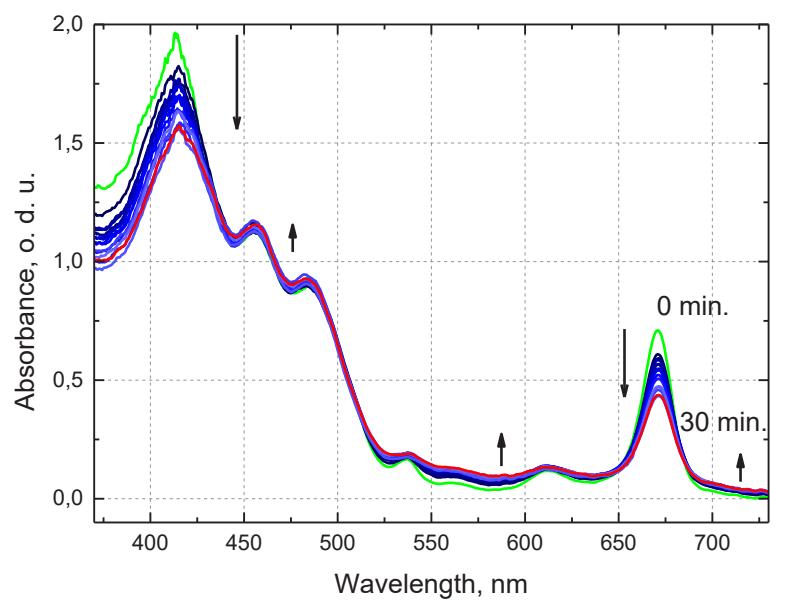
Upon irradiation of EVOO with blue LED light, chlorophyll might undergo two reactions: oxidation and reduction. While there is enough oxygen in the medium, it will oxidize chlorophylls, but if amount of oxygen decreases and a reducing agent is in the neighborhood, chlorophyll might be reduced and a photoreduction product might form.