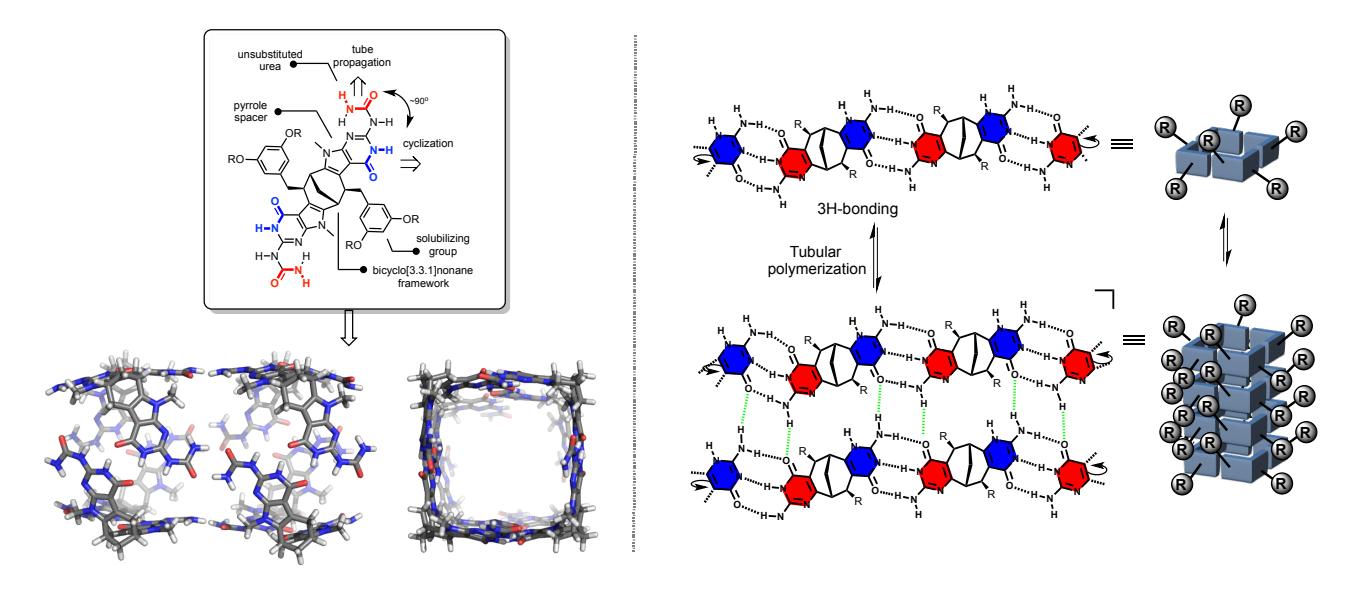
The tubular nanoscale self-assembled systems represent one of the most versatile constructs in the field of supramolecular chemistry.[1] The wall of the tube separates the bulk environment into two distinct regions- interior and exterior, having different chemical and physical properties. Moreover, the open-ended topology of these aggregates allows the facile entry of different molecular entities and therefore, they are very attractive for the application in transport, flow-through catalysis, separation and detection. The molecular scaffold of the tube may also act as a protective shell to isolate and stabilize otherwise very sensitive or highly aggregative molecules, such as conjugated polymeric nanowires. In another approach, the merging of organic and inorganic chemistries is possible when organic molecular tubes are used as a growth template to construct coaxial, inorganic shell coated tubular architectures. For the successful realization of all the above envisioned applications, a reliable and flexible access to synthetically modifiable tubular structures is necessary.
Herein we present two conceptually new strategies to achieve tubular polymerization using the hydrogen-bonding building blocks, the scaffold of which is composed of only nine carbon atoms. The careful design of hydrogen-bonding units and their spatial arrangement allowed the construction of both, discrete and polymeric tubular assemblies possessing large cavity.[2,3]