
Tritium (3H or T) is a radioactive isotope of hydrogen with a nucleus containing two neutrons and one proton. Its concentration (or activity) in substance are expressed in tritium units (TU). The origin of 3H in environment could be natural or anthropogenic. Anthropogenic tritium occurredin the atmosphere during the detonation of thermonuclear bombs in 1954–1964 [2]. In the atmosphere, tritium reacts with oxygen forming tritium water (THO or 3HHO) [1]. As tritium becomes a part of water molecule, no chemical reactions can alter its amount and 3H could be used as a reliable traser. As anthropogenic tritium spreads globally, precipitation constantly recharges groundwater and 3H reach shallow freshwater aquifers. Due to processes in aquifers and nature of tritium itself – the amount and 3H activity constantly changes. Decrease of tritium activity through time depends on radioactive decay and water mixing in the aquifers.
This study includes one unconfined and five confined aquifers of active exchange zone in south-eastern Lithuania. These aquifers were formed during Quaternary period, between major glaciations: Waalian interglacial (Dzūkija–Dainava, ag II dz-dn), Holsteinian interglacial (Dainava–Žemaitija, ag II dn-žm), Drenthian-Warthian interglacial (Žemaitija–Medininkai,ag II žm-md), Eemian-Middle Weichselian interglacial/interstadial (Medininkai–Grūda,ag II-III md-gr), Upper Weichselian interstadial (Grūda–Baltija,ag III gr-bl). The number of aquifers were reduced to three because ag III bl-gr and ag II dz-dn are of limited occurrence and was combined with respectively, ag II-III md-gr and ag II žm-dn [4]. Using literature sources, previous research and databases, a graph of tritium activity change during the period 1980–2012 was made (Fig. 1). In addition to groundwater, 3H activity trends of precipitation in Ignalina (Lithuania), Vienna (Austria) and Ottawa (Canada) are included [2, 3, 5].
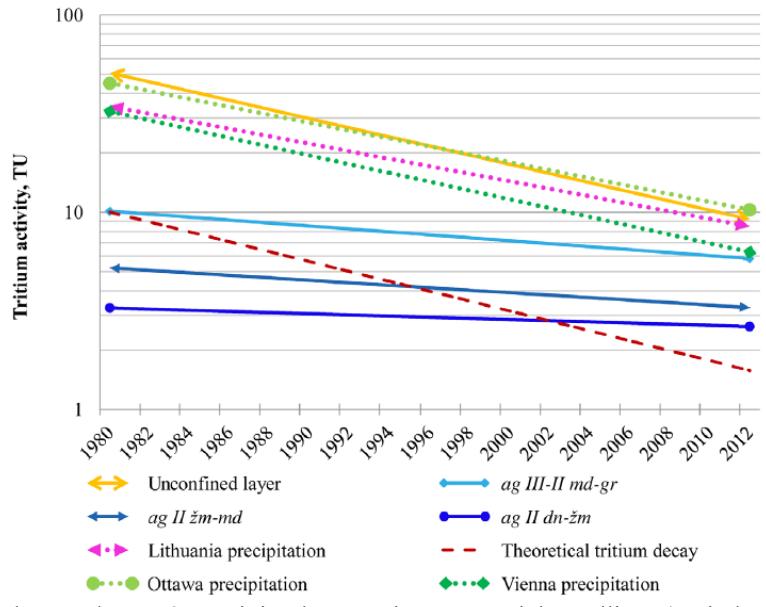
In Figure 1an inclination of precipitation trends are similar comparing to the radioactive decay line.The 3H activity decrease rate is mainly determined by radioactive decay of tritium isotope. Absolute tritium values in Ottawa, Vienna and Lithuania precipitation vary, because of uneven 3H distribution in the atmosphere. It led to differences in precipitation water activity around the globe. Trend inclination in unconfined layer groundwater shows that decrease rate is determined by radioactive decay. Unconfined aquifer water absolute tritium values are greater than in precipitation recharging it. Accumulation of tritium in unconfined aquifer groundwater appeared because circulation rate in atmosphere is much rapid than in the aquifer. It means that equilibrium between unconfined layer groundwater and precipitation is reached. Confined aquifers 3H activity trend inclination is considerably smaller indicating that anthropogenic 3H reached the aquifers, but equilibrium with precipitation are not reached yet. The deeper aquifer is situated the smaller 3H values are observed.