
We present the results of investigation and applications of the volume holographic elements in microscopy. The volume phase holograms are formed in a thin (100-200μm) layers of polymethylmethacrylate containing 2-3 mol. % of phenanthrenequinone (PQ-PMMA) [1]. The idea of the work is to create holographic elements of two types: for the selective excitation and for simultaneously detection of the emission from different depths of the sample [2].
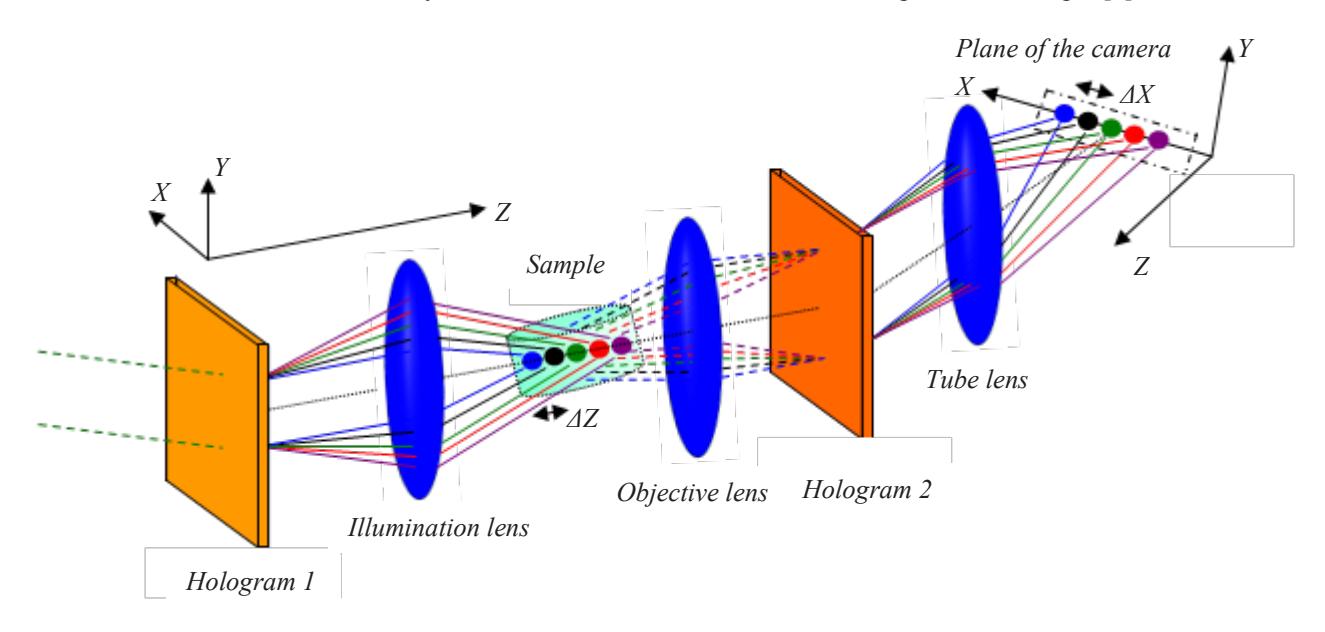
Figure 1 shows the scheme of the realization of the microscope with such holographic elements. Excitation light beam falls on the first holographic element by Bragg angle. Hologram 1 is the hologram for selective excitation. It forms diffracted beams with different divergence. Then, diffracted light is focused into the different areas within the sample by the illumination lens.
Fluorescence light from the sample is captured and transferred to the Hologram 2 by the objective lens. Hologram 2 is the multiplexed multifocus hologram. Light, illuminated from different Z position in the sample, will diffract by different angle in XZ plane. Tube lens forms images of different depths of the sample along X axis on the camera simultaneously.
Characteristics (selectivity, diffraction efficiency) of the holograms are investigated theoretically (by Kogelnik's coupled wave theory [3]) and experimentally. It is also mentioned about the possibility of using of the singular light beams to improve parameters of the volume holographic microscopy.