
Terahertz (THz) radiation represents the region in the electromagnetic spectrum between far-infrared and microwave radiation and has frequency between 0.1 THz and 10 THz (wavelength varies from 3 mm to 0.03 mm). Terahertz radiation has been investigated by scientists and engineers for over a decade; however compact and efficient THz sources and detectors are still to be developed. Therefore the research efforts in this field are rising, because THz radiation has many interesting and unique properties: for example it is non-ionizing, but safe for the living organisms. Moreover, it can easily pass through wood, paper, clothing, various plastics and ceramics. Furthermore, rotational and vibrational transitions of various molecules have energies in THz frequency range. This leads to a wide range of applications, such as spectroscopy, biological and medical imaging, detection of hazardous materials, security screening, etc.
We have conducted experiments using two different methods. In both of them THz radiation was generated in ambient air. As a pump source the Ti:Sapphire laser system (central wavelength about 790 nm) operating at 1 kHz and delivering 9 mJ pulses of 35 fs (FWHM) duration was used. In the first experiment THz radiation was generated by mixing laser and its second harmonic pulses (bichromatic pump). The second experiment was more complicated, since for the air excitation we have used three laser pulses of different wavelengths: the laser radiation along with the signal (1140-1600 nm) and idler (1600-2600 nm) wavesof the Optical Parametric Amplifier (OPA), pumped by the same Ti:Sapphire laser.
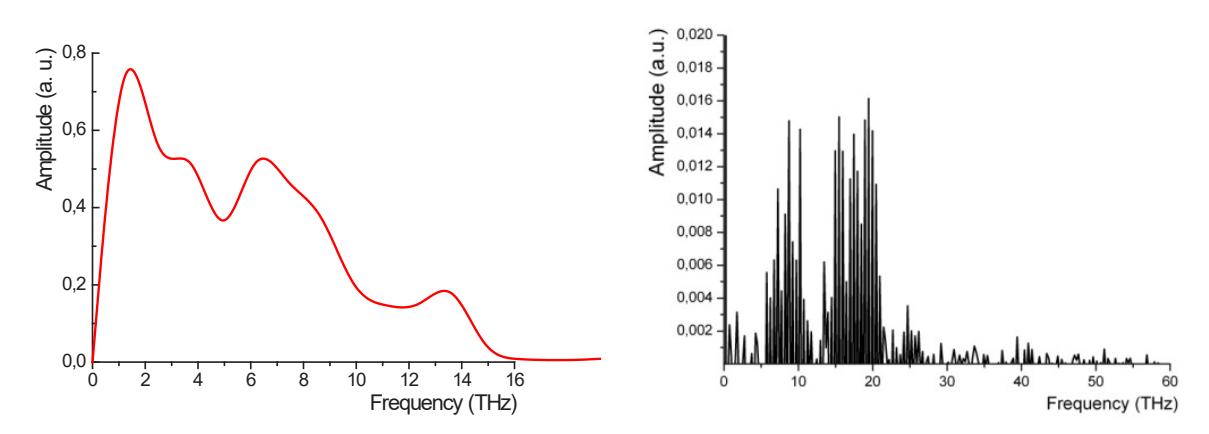
During the experiments the dependencies of various THz radiation properties (spectral properties, divergence and generation efficiency) on the pump pulse energy and wavelength have been investigated. Though in both cases (two- and three-colour pump) conical THz emission with the apex angle of a few degrees was generated, the three-colour excitation was found to be more efficient than that obtained using the bichromatic pump pulses. In addition, the spectral width of THz emission generated by three-colour pump pulses was considerably larger in comparison with the spectrum of THz radiation, induced by two-colour laser pulses.
In conclusion, spatial and spectral characteristics of THz radiation, generated in air by both the two- and three-colour femtosecond laser pulses have been investigated. The obtained results indicate that both methods are suitable for the broadband (of over 10 THz) THz radiation generation.