
Tetrahydrofuran (THF, oxolane), cyclic ether with formula (CH2)4O, is widely used the industry applications[1] despite its probable toxic effect to the environment. Nowadays THF is used as a precursor of biologically active molecules, as a monomer in polymerisation reactions, what is more THF might be treated as a simple model of deoxyribose in the DNA chain in electron interactions researches[2].
The high-level ab initio calculations show that the global minimum of the THF molecule in a gas phase has an envelope (Cs) structure[3,4,5]. According to the latest benchmark calculations the absolute energy difference between the global minimum (Cs) and the first local minima, the twisted conformation (C2), is only 0,59 kJ/ mol-1.[6] Such low differences between global and local minima suggest almost barrierless adaptation from one conformer to another at finite temperature.
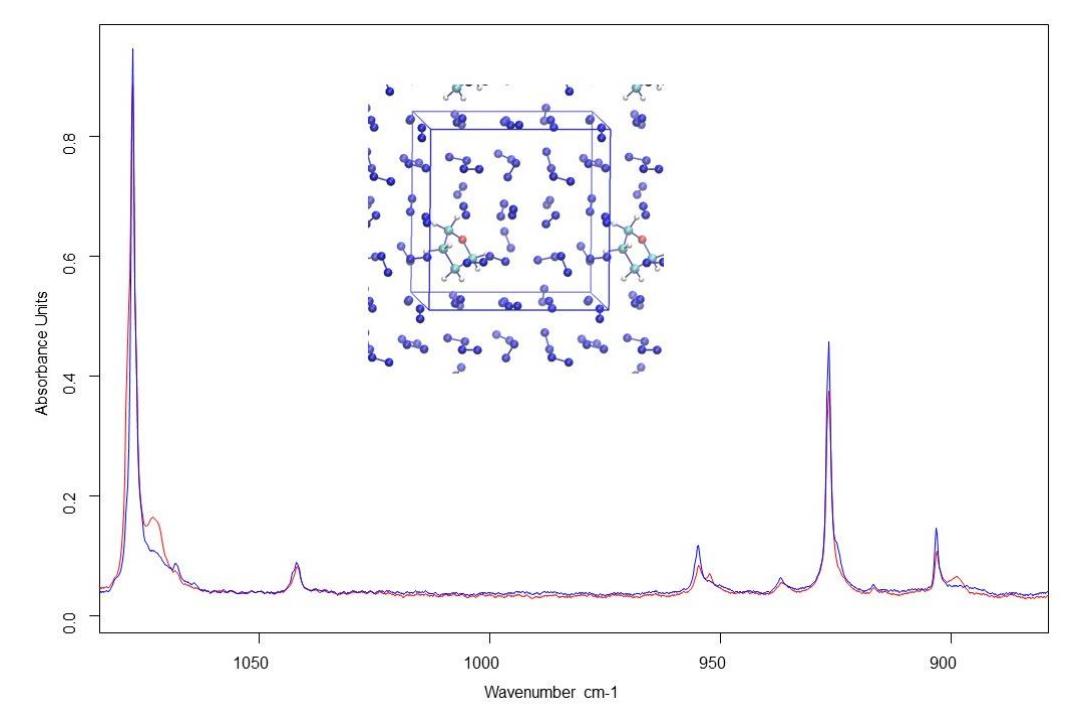
The spectra were collected after 1 hour deposition of the THF:N2 mixture (ratio 0.5:500 mba) in 9 K and after annealing (heating up to 25 K and cooling down to 9 K.Matrix isolation infrared absorption experiments reveled that both conformers are observable in the low temperature nitrogen matrices.
The dynamics of the model THF in N2 system and the structural rearrangements between the local and global minima have been studied at finite temperature by Car-Parrinello molecular dynamics (CP-MD) simulations. CP-MD calculations proves that the global minimum structure is envelope conformer. We can observe transformation of the conformation from envelope to twisted and backward, what suggest that the nitrogen matrix might induce the pseudorotation even in such low temperatures.