In recent years terahertz (THz) spectroscopy finds its application in various fields. It could be used in security systems for drugs and explosives detection [1], in medicine as non-invasive way for cancer diagnostic [2], in food industry for quality control [3], in art for heritage restoration [4] and ect. Moreover THz spectroscopy is a good tool to investigate semiconductors and their nanostructures: it could be used for electron mobility and relaxation time measurements [5] as well as for determination of semiconductor band gap and intervalley separation [6]. For all these applications an effective, compact, easy to use and cheap THz emitter is needed. It was shown that THz radiation from surface based THz emitters could be determined by the photo-excited electric dipoles which orientation is essential for an efficiency of THz emission. In this work we present an experimental method which together with theoretic calculations based on W. Lukosz [7] theory could be used to determine the orientation of THz radiating electric dipole.
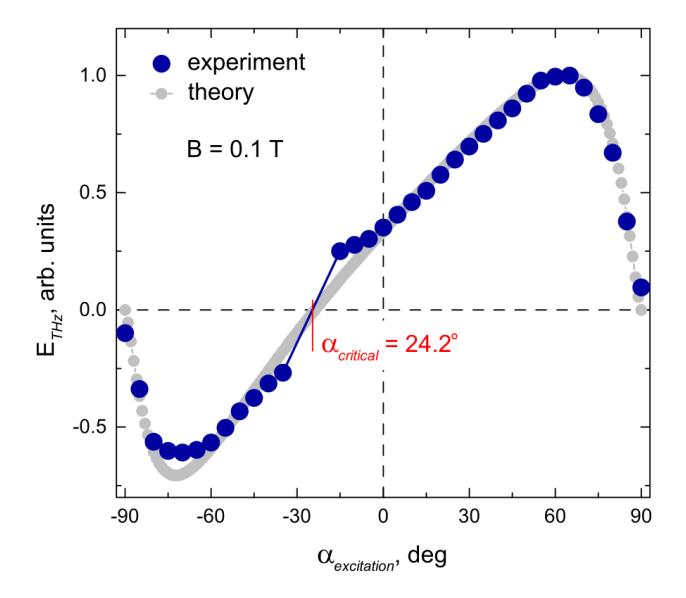
Experiments have been performed using Ti:sapphire oscillator generating 150 fs, 800 nm pulses at the repetition rate of 76 MHz. THz electric field transients were detected with a GaAs THz detector (Teravil Ltd) which was positioned to detect only p polarized THz radiation. THz emission measurements were carried out in transmission geometry. THz pulse amplitude dependencies on an angle between an incident laser beam and a normal to the sample surface, so called an excitation angle, have been obtained. To change THz radiating electric dipole orientation an external magnetic field ranging from 0.0 T to 0.4 T was applied using an electromagnet. The magnetic field was parallel to the sample surface and perpendicular to the incidence plane. Critical excitation angle $\alpha_{\text{critical}}$ (where THz pulse amplitude equals zero) was determined from THz pulse amplitude dependence on an excitation angle measurements. According to obtained results a tilt angle $\theta$ of THz radiating electric dipole was calculated. It was shown that our suggested theoretical model is in a good agreement with measurement results (Fig. 1). Described method was adjusted for investigation of non-stoichiometric GaAs layer. It was determined that THz radiating electric dipole in this structure is tilted by an angel $\theta$ = 8° in respect to surface normal which leads to effective THz pulse generation. Investigated structure was used for fabrication of compact, bias-free, polarization rotating THz emitter [8].