Generally the process of fatigue has two stages: the stage before a crack initiation and the stage of development of the crack. The ratio between the lengths of these stages varies widely depending on the level of stresses, loading scheme, size and shape of the object, material properties, etc. In some cases, the stage of development of the main crack can be 60 ... 90% of the overall durability.
Results of two-dimensional computer simulation of crack-like damage propagation in time for different equivalent stresses is considered in the paper. The simulation was made basing on the model of deformable solid with a dangerous volume by deleting the dangerous surfaces at each step of loading [1].
The dangerous volume is the volume which consists of the elements, in which the values of the stress exceeds the limiting stress. While considering a two-dimensional problem dangerous volume becomes dangerous area.
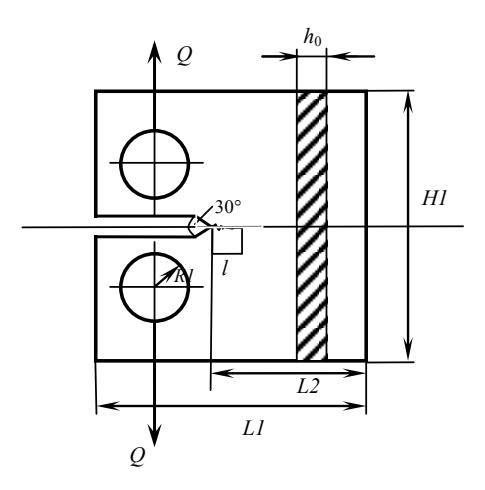
For our work we considered this standard sample used in fracture toughness research. The following dimensions of the sample shown in Fig. 1 were considered for calculations: L1=0.0625 m, Н1=0.06 m, L2=0.04 m, R1=0.00625 m, Q=15000 N – 20000 N.
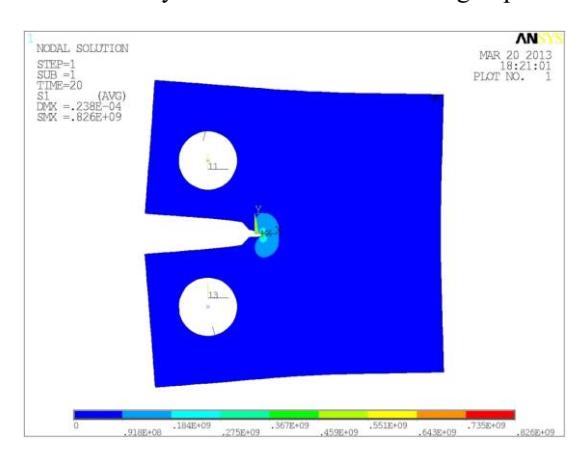
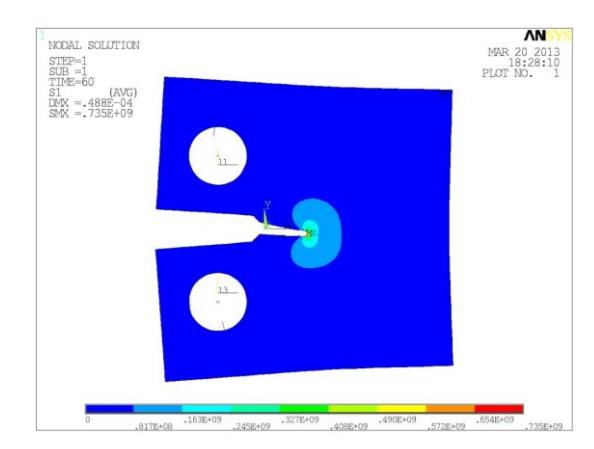
Figures 2 and 3 show the illustration of deformed flat sample at different steps of loading for Q equals 15 000 N. It's seen from the figures that the crack propagates in the longitudinal direction and the maximum values of the stress intensity are at the crack-like damage tip.