White light can be generated in different ways. The simplest one is to mix blue and yellow/orange. However, it is also possible to mix blue, green and red. Blending a number of emission bands into a continuous spectrum also yields, of course, white light [1]. The object of this work was to find new and efficient red emitting inorganic phosphors that could be applied in white LEDs.
Powder samples of inorganic phosphors were prepared by conventional high temperature solid-state reaction. The stoichiometric amounts of high purity starting materials (Bi2O3, Sm2O3, MoO3, K2CO3/ Rb2CO3 and NH4H2PO4) were blended in the mortar employing acetone as grinding media. The obtained powders were transferred to the porcelain crucibles and annealed at 600 °C for 10 h in air. The calcination procedure was repeated another two times [2].
Three different series were made as follows: K2Bi(PO4)(MoO4) and Rb2Bi(PO4)(MoO4) doped with Eu3+ and K2Bi(PO4)(MoO4) doped with Sm3+ ions. The structural, morphological and optical characteristics of the compounds were investigated by powder X-ray diffraction (XRD), scanning electron microscopy (SEM) analysis and UV-Visible spectroscopy. The reflection, excitation and emission spectra of the single phase compounds were measured and analyzed. The temperature dependent emission spectra and decay curves in 77 – 500 K temperature interval were also recorded and discussed.
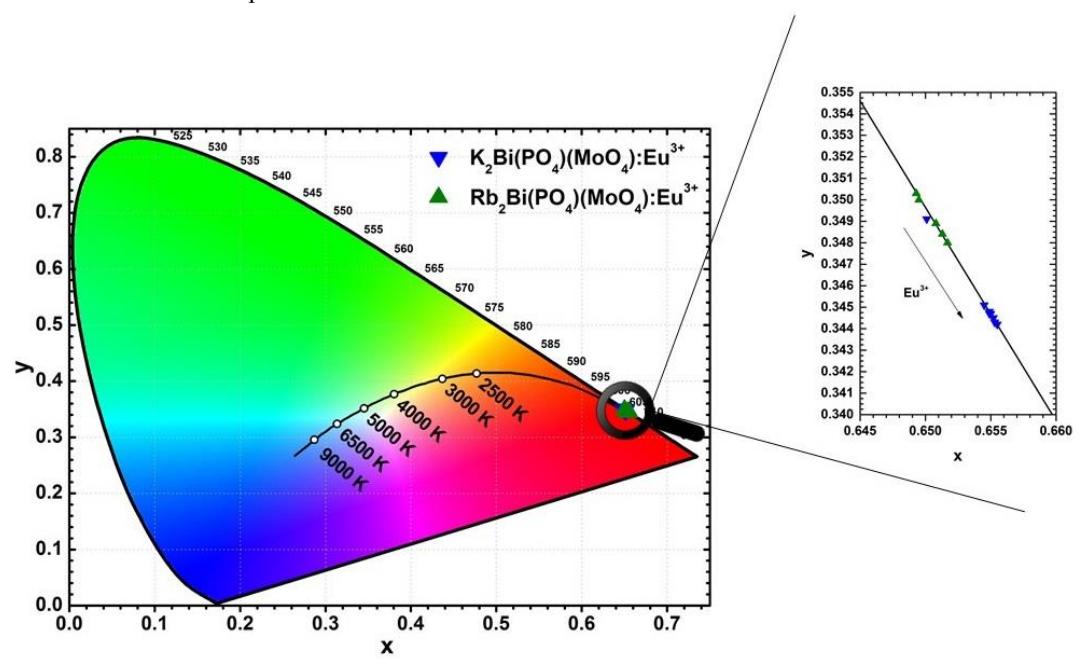
Moreover, colour points, luminous efficacies (LE) and decay times were also calculated. Eu3+ doped samples were red emitting and showed quantum efficiencies close to unity, whereas their Sm3+ counterparts possessed around 55% efficiency.
Differences between colour points (see Fig. 1), colour purity, luminous efficacy of mentioned series as a function of Eu3+ or Sm3+ concentration will be presented and discussed.