INVESTIGATION OF RECOMBINATION MECHANISM IN GREEN OLET INCORPORATING TPBI AS ELECTRON TRANSPORT LAYER
Vishwa Bhatt1, Mihirsinh Chauhan1, Khushdeep Kaur4, Vaibhav Rao2, Pankaj Yadav3, Brijesh Tripathi3, U. K. Dwivedi5, Manoj Kumar3
1 Department of Solar Energy, School of Technology, Pandit Deendayal Petroleum University, Gandhinagar – 382007 (India).
2 Ultrasound Research Institute (Electrical and electronic Engineering),Kaunas University of Technology, Kaunas, 44249(Lithuania).
3 Department of Science, School of Technology, Pandit Deendayal Petroleum University, Gandhinagar – 382007 (India).
4 Department of Electronic Science, Kurukshetra University, Kurukshetra – 136119 (India).
5 Amity School of Engineering and Technology, Amity University, Jaipur – 302006 (India).
OLETs are relatively new opto-electronic devices showing good light emitting proprieties with switching action like a transistor [1-3]. These kind of multifunctionality of the device is very useful in the applications such as cell phones, PDA (Personal Digital Assistance), digital cameras etc. [4,15]. Despite of these developments, many issues such as low device efficiency, poor long term efficiency, low external quantum efficiency etc need to be explored further. In an OLET, electroluminescent emission layer (EL) is sandwiched between electron and hole transport layers and the performance is mainly dependent on the charge-transport properties of the EL emission layer.
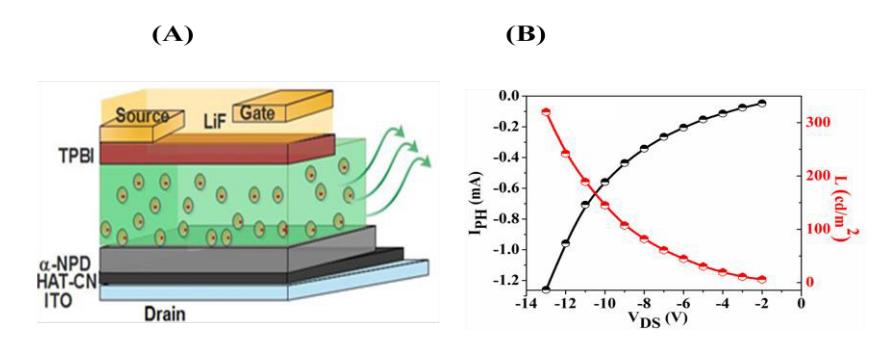
In this article, the electric charge transport properties of 1,3,5-tris(N-phenyl benzimidazole-2-yl)benzene (TPBI) as an electron transport layer and its effect on the light emission pattern of the OLETs has been investigated. The mobility, maximum $I_{PH}$, maximum brightness, ON/OFF ratio, efficiency, and external quantum efficiency (EQE) of the device are explored using the current-voltage characteristics of the device and the light emission properties have been explored using electroluminescence measurements. The maximum current and luminance obtained for TPBI based device is 1.3 mA and 325 cd m-2. The max obtained EQE is 1.271% with the maximum current efficiency of 1.05 cd A-1.
Fig. 1. (A) Schematic diagram and (B) Current-Voltage luminance characteristics of OLET
[1] C. Zhang, P. Chen, W. Hu, Organic Light-Emitting Transistors: Materials, Device Configurations, and Operations, Small, 12 (2016) 1252-1294.
[2] S.Z. Bisri, T. Takenobu, Y. Yomogida, H. Shimotani, T. Yamao, S. Hotta, Y. Iwasa, High Mobility and Luminescent Efficiency in Organic Single-Crystal Light-Emitting Transistors, Advanced Functional Materials, 19 (2009) 1728-1735.
[3] M. Kitamura, T. Imada, Y. Arakawa, Organic light-emitting diodes driven by pentacene-based thin-film transistors, Applied Physics Letters, 83 (2003) 3410-3412.
[4] S. Verlaak, D. Cheyns, M. Debucquoy, V. Arkhipov, P. Heremans, Numerical simulation of tetracene light-emitting transistors: A detailed balance of exciton processes, Applied Physics Letters, 85 (2004) 2405-2407.
[5] C. Rost, S. Karg, W. Riess, M.A. Loi, M. Murgia, M. Muccini, Ambipolar light-emitting organic field-effect transistor, Applied Physics Letters, 85 (2004) 1613-1615.