In the previous decade, interesting compound of composition LiFeBO3 emerged as potential cathode material for lithium ion (Li-ion) batteries [1]. Its advantages are: low cost of raw materials and high (220 mAh/g) gravimetric capacity. Unfortunately, the materials in polycrystalline form, prepared by solid state reaction, exhibited low electric conductivity and insufficient gravimetric capacity. The capacity improved, when the material was obtained in nanocrystalline form. Other problems concerned high susceptibility of iron ions to oxidation, when material was kept in air atmosphere [2].
Here, we would like to present an alternative approach to synthesis of LiFeBO3, which allow to preserve its advantages while improving the disadvantages – a thermal nanocrystallization of amorphous precursors. We have successfully applied this method in case of Li2O–FeO–V2O5–P2O5 system – the heat-treated materials exhibited structure consisting of nanometer grains, presenting enhanced conductivity by a factor even of 108 [3]. This work presents the results of recent studies on LiFeBO3 glass and nanomaterial.
Pre-dried chemicals: Li2CO3, H3BO3 and FeC2O4·2H2O were homogenized and melted in alumina crucibles at 1200 °C for 25 minutes. Glass of nominal composition LiFeBO3 (25Li2O·50FeO·25B2O3) was obtained using melt-quenching method – the molten batch was poured onto metal plate and quickly pressed with another metal plate to guarantee fast cooling of the sample.
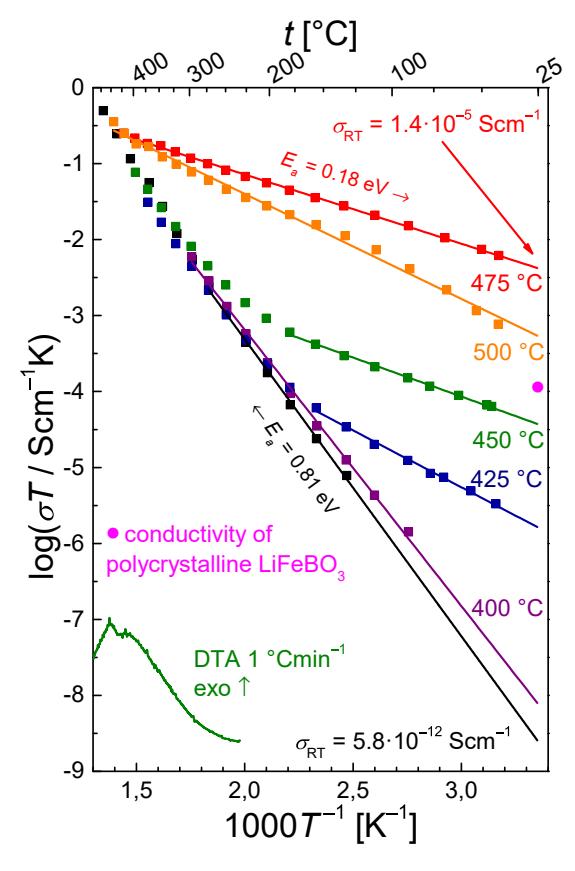
Thermal events were investigated using DTA Q600 calorimeter in 30–700 °C range in the argon flow. X-ray diffractometry (Phillips X'Pert Pro) was used to verify the amorphousness of as-received glasses and to examine crystal phases grown after thermal treatment. Temperature XRD measurements were performed in 30–650 °C range in nitrogen flow. Impedance spectroscopy measurements were performed using Solartron 1260 analyser in 10-2–107 Hz frequency range and 25–550 °C temperature range. The amplitude of voltage was equal to 0.1 V.