
Nowadays, the surface modification of solids by means of plasma flows has been intensively investigated. A pulsed plasma sources generating plasma flows with high energy density are also suitable for material processing [1].
A magneto-plasma compressor (MPC) is a quasistationary plasma accelerator capable of producing supersonic compression plasma flows (CPFs)[2]. The weakly diverging and possessing high energy density CPF have been used to modify a surface layer (up to tens of μm) in an extremely short time (~100 μs). The surface treatment of ferrous materials and various type of steels by CPFs was found to result in a significant improvement of their mechanical properties. In this connection, the modification of alloyed steels with different elements is of special interest[2].
In the present work, microstructure, phase composition, and mechanical properties of a plasma-mixed „Cromium-U9carbon steel” system have been investigated. In this technique, the action of relatively short (~100 μs) and high-energy (up to 19 J/cm2) plasma pulses lead to the melting of the near-surface layer of the steel substrate together with the pre-deposited Cr film (~2 μm thick), liquid phase mixing and subsequent high speed cooling resulting in the formation of steel surface layer alloyed with chromium atoms. Such teratment lead to surface layer structure and phase composition changes.
The results of the XRD (X-ray diffraction) analysis of the samples before and after CPF treatment at different energy densities absorbed by the target are presented in figure 1.
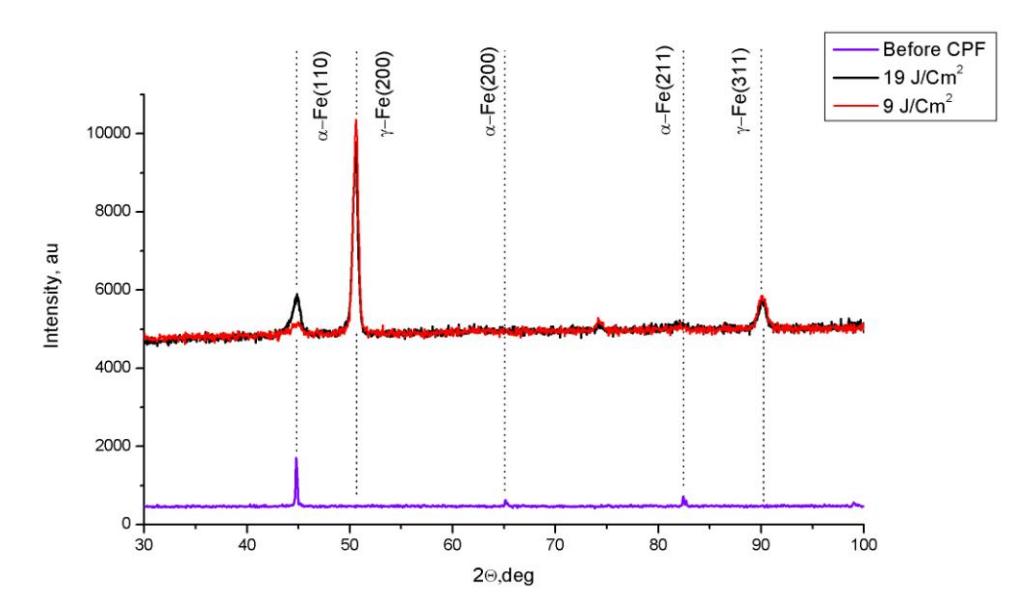
The findings showed that the CPF action results in to the formation of metastable austenite phases ($\gamma$-Fe) formed as a result of non-equilibrium crystallization. $\gamma$-Fe crystallites had preferred orientation (100) according to the XRD pattern. This orientation is typical for phases growing in conditions of high-speed cooling e.g. in case of laser treatment.
Surface morphology analysis showed formation of dendrites at the surface formed during high-speed-cooling from the melt. Their size was about 0.1-1 μm. The increase of the energy absorbed by the surface layer led to the decrease of the alloying element concentration at the surface of the alloyed layer. Cr concentration was changed in the range of 7.5-1.5 wt.% depending on the energy absorbed by the surface.
Compression plasma flows treatment influenced the mechanical properties of steel. CPFs treatment leads to an increase of Vickers microhardness up to 6.1 GPa. Steel microhardness before treatment was 2.3 GPa. Microhardness increase was connected with grain-boundary and solid-solution strengthening.