
Crystalline vanadium oxide (V) has layered structure, so it has the ability of reversible intercalation and deintercalation of many cations, such as e.g. lithium, sodium, magnesium. Its been examined long time ago, that it has features/capability to be used as material for cathodes in lithium batteries. Recently, interest in V2O5 increased again, because of possible applications in magnesium [1] and sodium batteries.
Vitreous magnesium-vanadate-phosphate (90MgV2O5·10P2O5) samples prepared by melt quenching technique. Weighted chemicals (NH4H2PO4 (POCh – Polish Chemicals, 99.5%) and V2O5 (Aldrich, 99.6%)), MgO (Aldrich, 99.5%)) were mixed in a mortar and as powder, put into alumina crucibles. The compound was heated to 1300°C in air, and held at this temperature for 15 minutes. The molten batch was rapidly poured onto a stainless-steel plate and pressed with another plate. XRD (X-ray diffractometry) measurements were carried out to check amorphousness of the as-received sample. This research was carried out using Philips XPert aparatus. Glass transition and crystallization temperatures were determined from DSC measurements using a SDT Q200 setup (TA Instruments). Electrical conductivity was meausred with DC method as a function of temperature. The sample was kept in a tube furnace (Czylok) and its temperature was stabilized with Eurotherm 2404 temperature controller. The temperature of the sample was measured with a separate termocouple and Adam 4011.
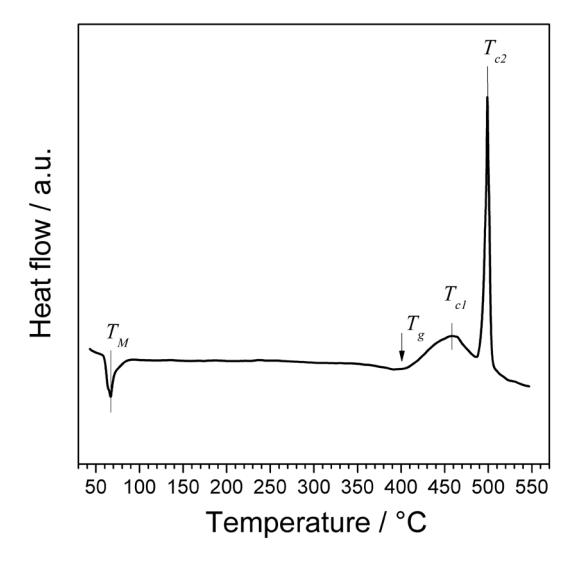
DSC trace of as-received sample was typical for glassy material. In Fig. 1 one can see a glass transition followed by two crystallization peaks: a broad one and a narrow one. The characteristic temperatures are as follow: Tg = 396°C, Tc1 = 455°C and Tc2 = 499°C. In addition to this, an endotermic peak is observed at low temperatures. The onset is at 60°C and the minimum of the peak at Tm = 67°C.
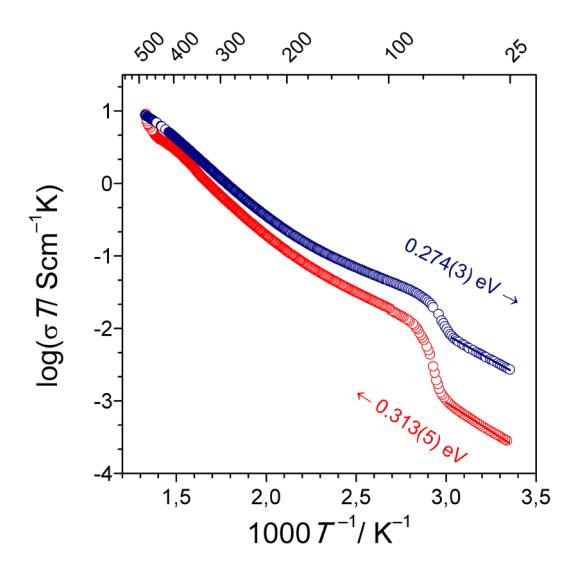
An example of electrical conductivity heated up to 480°C and cooled down to room temperature is presented in the Arrhenius plot (Fig. 2). As expected, graph is typical for vanadate glasses that undergo nanocrystallization. The activation energy of sample was 0.313 eV. The conductivity of glass was equal to 8·10-7 S/cm. Furthermore, one can see a conductivity drop at 60°C. Such transition, which is observable also in DSC trace of the sample, can be ascribed to metal-to-insulator transition in VO2 [4].