
This study is aimed the investigation of the Si/P+ structure, processed in hydrogen plasma. The processing was made at 150 °C during 10 hour. The spectra of Raman light scattering were recorded at room temperature using a Nanofinder High End (Lotis TII) – micro-Raman spectrometer, combined with 3D scanning confocal microscope. The spectra were recorded by the backscattering method, the resolution of the spectrometer was 0, 3 cm-1. For the excitation, solid-state laser with a wavelength of 532 nm was used.
Figure 1(a) illustrates the spectra of Raman light scattering in the test samples after the 10 hours treatment in H-plasma (1) and after additional annealing at 275 °C for 20 minutes (2). In the first case, there are two intensive peaks detected at 2095 (Si-H) and 2129 cm-1 (1). Peak at 2095 cm-1 is related to silicon amorphization after the hydrogenation due to the formation of defects. The one peak at 2125 cm-1 with max indicator appear after an additional short annealing. This peak corresponds to the vibrations of bonds (Si-H2) in platelets [1]. Additional heat treatment leads enhancement of the crystal structure and zone at 2095 cm-1 begins to disappear, because the annealing of main radiation donor -vacancy donor [2].
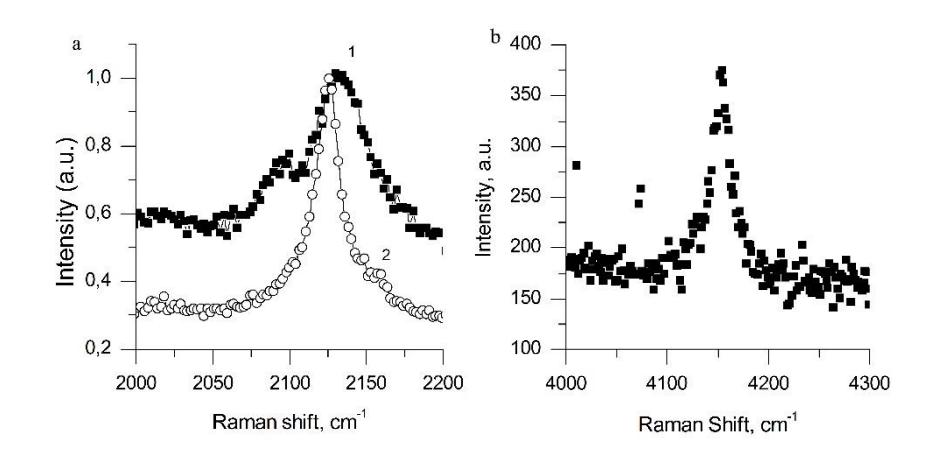
On the figure 1(b) one can see the spectra of Raman light scattering in the samples after the plasma treatment and further annealing. There is the peak at 4153 cm-1, which is caused by the oscillations in hydrogen molecule. This frequency coincides with that of the hydrogen gas in [3]. Total energy of a hydrogen molecule is lower than the total energy of the two isolated neutral hydrogen atoms, and annealing of radiation defects leads to the restoration of broken bonds and the release of hydrogen released from the bound state. Indeed, the binding energy of the gap is about 1.8 eV, while the energy of diffusion of atomic hydrogen -is about 0.48 eV [3].
The work deals with the reasons for the origin of the H2* molecules and their interactions.