
Nowadays various methods to enhance the proliferative activity of the cells are being actively studied and developed. For this reason, more attention is paid to the use of cells electrical stimulation due to its obvious advantages. However, there is a lack of sufficient data in the literature on the influence of electric field on cells in culture. Because of the large number of variables of the electric field stimulation, there is currently the problem of choosing appropriate parameters of electrical stimulation as a result of the large number of variables of the electric field. Thus, the study of the effects of electrical stimulation on rat glioma cells proliferation in culture only by varying one parameter of the electrial stimulation is of great importance.
To study the effect of electrical stimulation the rat glioma cells C6 were used, cultured under standard conditions (in a humidified atmosphere of 5% CO2 content at 37 °C). Stimulation of cells in culture was performed with uniform alternating electric field during the 12 hours with the electric field strength of 6,6 V/m (1, 3 and 5 stimulation pulse in train). The electrical stimulation was started 8 hours after seeding the cells on the Petri dish, which corresponded – G1-S checkpoint or early S-phase. The proliferative activity was counted as the change in the number of cells after electrical stimulation relative to the control sample.
As a result of electrical stimulation the increase of proliferative activity of the rat glioma cells was revealed. It was shown that the initial increase in the number of pulses in the train (up to 3 stimulating pulses) leads to acceleration of proliferation, while a further increase in pacing pulses to 5 accompanied by a reduction in proliferative activity of the cells. It was found that maximum gain proliferative activity of rat glioma cell line C6 observed with three pacing pulses (statistical significance of differences> 95%).
The increase in proliferative activity may be due to the acceleration of the cell cycle S-phase cells due to depolarization of the plasma membrane. In turn, reduction of proliferative activity was due to hyperpolarization of the cell membrane, which caused a slowdown passage cell of the cell cycle [1].
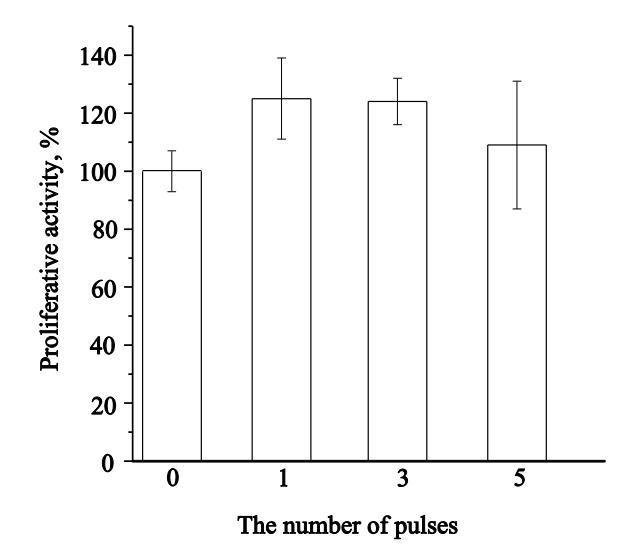
Thus, it was shown that the proliferative activity of C6 cells in culture can be regulated by selecting suitable parameters of electrical stimulation, in this case the number of stimulating pulses. The results of these studies can be used as a basis for the further development of effective methods for cell and tissue engineering.