
For the past 40-50 years, lead based perovskite Pb(ZrxTi1-x)O3 (PZT) piezoelectric ceramics have dominated the commercial market of piezoelectric devices due to their remarkable dielectric and piezoelectric properties and ability to operate in wide temperature range.
BaTiO3 (BT) is perhaps the most widely researched perovskite in the last decades. Inserting potassium niobate (KN) into BT structure creates stresses that increase domain wall count and in result piezoelectric coefficient [1]. KNBT has comparable piezoelectric coefficient with PZT, thus making it a great substitute. The fact that KNBT is lead free ceramic makes it of high interest for both researchers and engineers due to environmental concerns.
KNBT composites were prepared in two steps: compact BT particles were heated up to 1000 °C and heat-treated at that temperature for 2h to create low-density ceramics, then KN were epitaxially deposited into BT structure. [2].
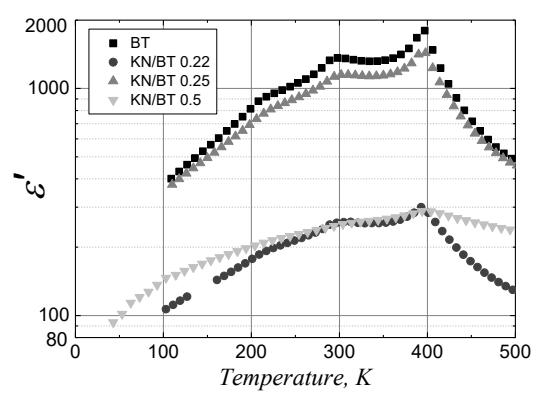
In this presentation dielectric properties of KNBT with different KN/BT molar ratios will be presented. From Figure 1 we can observe that the bigger the KN/BT ratio is, the more obscured phase transitions of BaTiO3 become. Low dielectric permittivities in KN/BT with molar ratios of 0.22 and 0.5 can be explained by its low relative density.
Furthermore, experimental data of the frequency dependences were approximated by superposition of 3 Cole-Cole equations (Fig 2). Three relaxation processes were distinguished: Maxwell – Wagner relaxation (1), domain wall motion (2) and electro – mechanical resonance (3). Additionally we can see that relaxation times of the third relaxation process has no temperature dependence and it contributes to dielectric permittivity the most.
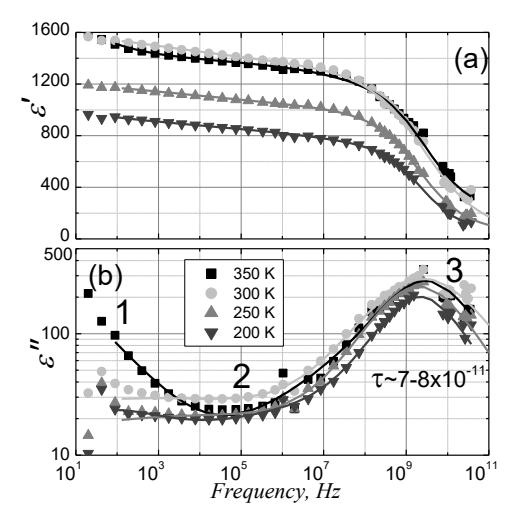
Lastly, the model proposed by Arlt [3] was used to calculate spontaneous polarization from electro – mechanical resonance contribution to dielectric permittivity and showed promising results. Also, theoretical models of electro - mechanical resonance will be presented.