
Laser emission near 1342 nm has applications in micromachining, deep-UV laser source development for lithography at 224 nm and 192 nm, manufacturing of fiber Bragg gratings and surgical treatment [1,2]. Efficient wavelength conversion into the red 671 nm by second harmonic generation (SHG) or into the blue 447 nm by the sum frequency mixing (THG) is attractive for laser TV, laser printing, medical diagnostics and treatment, underwater communication. Sixth harmonics wavelength at 224 nm is promising for micromachining of polytetrafluoro- ethylene (PTFE), well known commercially as TeflonTM. We describe the development of high repetition rate multiply wavelength: NIR-Visible-UV mode-locked laser covering a wide range of these applications with a focus towards the efficient generation of the 6th harmonic at 224 nm.
Picked from the oscillator train, picosecond seed pulses were injected into the cavity of the regenerative amplifier based on pumped at 880 nm wavelength composite Nd:YVO4 crystal with diffusion-bonded segments of multiple Nd doping concentration [2]. We used 4×4×15 mm3 type-I LBO (${\theta}$ = 85.2°, ${\phi}$ = 0°) nonlinear conversion crystal for SHG and 4×4×10 mm3 type-I LBO (${\theta}$ = 90°, ${\phi}$ = 19.6°) crystal for THG. Two different length of type-I BBO (${\theta}$ = 64°, ${\phi}$ = 90°) crystal were used for sixth harmonic generation: 6×5×3 mm3 and 6×5×6 mm3.
Developed laser emits 13 ps output pulses of 10 W average power at 1342 nm wavelength and ensures the energy stability of StDev ± 1 % at 300 kHz repetition rate with output beam quality of M2 < 1.1. Conversion to 671, 447 and 224 nm with efficiency of up to 80%, 50% and ~ 8% was achieved. The average power reaches 6 W in red with pulse energy stability of StDev ± 1.5 % featuring beam quality of M2 ~ 1.09 with 0.9 output beam ellipticity, amounts over 4 W in blue with pulse energy stability of StDev ± 1.5 % featuring beam quality of M2 ~ 1.12 with 0.83 beam ellipticity and is limited by ~ 0.7 W in UV featuring beam propagation factor of M2 ~ 1.4 with 0.87 output beam ellipticity.
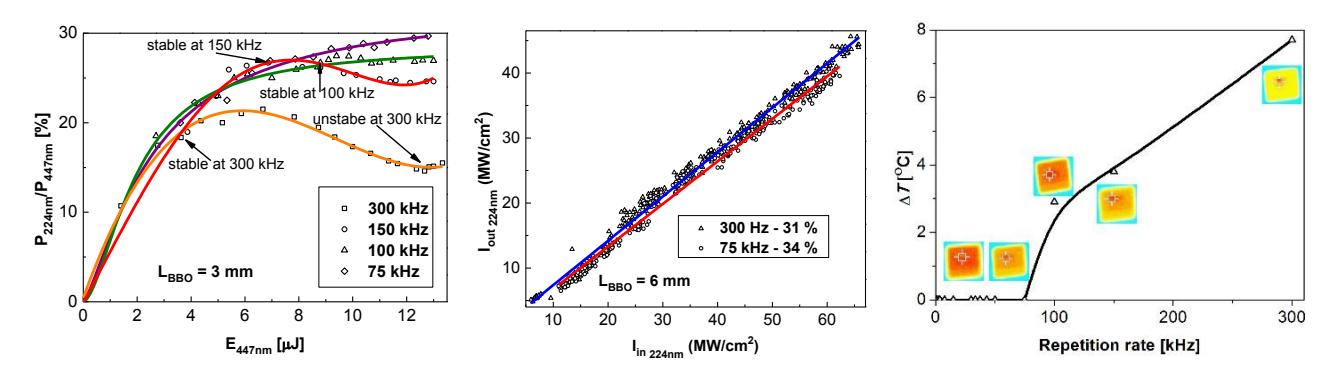
Conversion efficiency to the sixth harmonic displays a rollover at the repetition rates exceeding 75 kHz (Fig. 1, left) with increasingly unstable behaviour beyond the rollover until the collapse. To identify possible causes for limited conversion we measured transmission in BBO at 224 nm wavelength using another crystal of 6 mm length (Fig. 1, center). It is easily seen that despite considerable scatter of the experimental points caused by the shot-to-shot energy instability of probe pulses, the transmitted versus incident power density is approximated well by a straight line corresponding to linear absorption of ~ 31 ÷ 34 %. Accordingly, we didn't observe an impact of two-photon absorption in the range of incident power densities from 7 to 70 MW/cm2. Further measurements of temperature gradient induced at the exit face of BBO crystal by linear absorption of UV radiation at 224 nm (Fig. 1, right) demonstrate a threshold at 75 kHz followed by substantial growth of temperature difference up to to 8°C at 300 kHz. Insets (Fig.1, right) show the temperature distribution maps recorded with thermal imaging camera "Fluke Ti10". We enhanced the contrast here to reveal the hot caustic that is clearly seen at 150 ÷ 300 kHz repetition rates.
Designed ultrafast Nd:YVO4 laser demonstrates the highest average output power achieved at 1342 nm wavelength. Fundamental radiation at 1342 nm from this laser was further converted to the 2nd, 3rd and 6th harmonics at 671, 447 and 224 nm wavelength. To improve the conversion efficiency to 224 nm wavelength at repetition rates exceeding 50 kHz we designed and manufactured special crystal oven providing the longitudinal temperature gradient.