Ionic liquids (ILs) are organic salts, characterized by a remarkably low melting temperature (<100°), and by many useful properties (e.g. electrical conductivity, high thermal stability, high solvating capability, etc.) which can be tuned by modifying the anion or cation. The need of designing ILs with desired properties had stimulated a large amount of investigations. Among the experimental techniques used to this purpose, we are interested in the nuclear magnetic resonance (NMR) signal of the quadrupolar nuclei, particularly of the halides which are common anions in ILs.
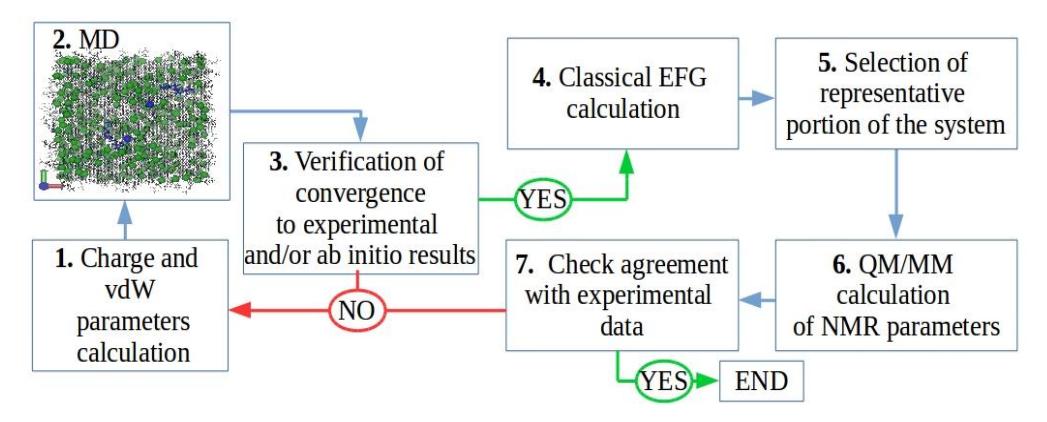
We use classical MD, coupled with QM and QM/MM calculations, to understand how the structure and dynamics of ILs at the atomistic and sub-atomistic level affects the NMR signal of quadrupolar nuclei [1] and what information can be extracted from the experimental signals. The work presented in this symposium concerns stages 1-3 of the scheme in Fig.1, and is focused on the improvement of the currently used force field parameters in order to improve the description of the interactions between anions and cation of 1-decyl-3-methyl-imidazolium chloride (DMimCl). To this aim we improved the partial and total charges by performing QM calculations and varying the van der Waals parameters. The atomic charges were calculated using Gaussian 09 program, with the restrained electrostatic potential (RESP) approach by fitting the electrostatic potential grid computed at the B3LYP DFT level on the optimized geometries. The new set of AMBER parameters has been validated by comparing the structural and dynamical behavior of investigated systems by means of MD simulations with QM data and experimental evidence. A very good agreement with reference data (ab initio [2] and experimental) has been obtained for all of the investigated structural and dynamical properties.